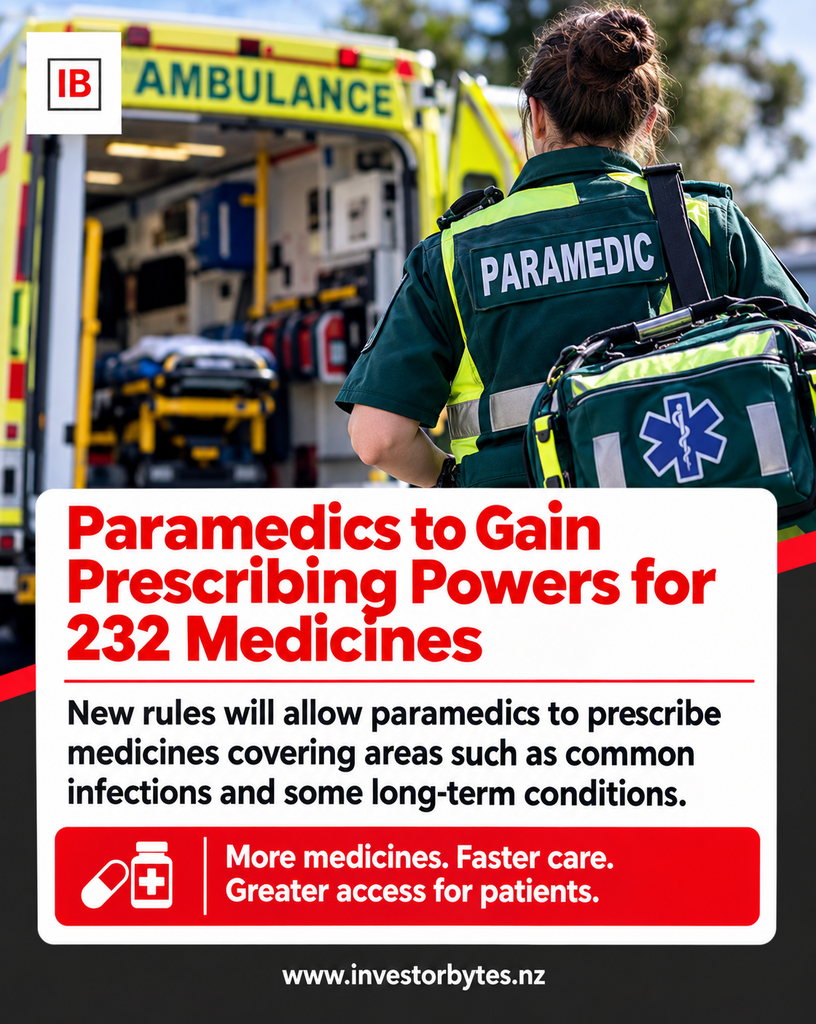
Paramedics Gain Prescribing Powers
Paramedics Prescribing Powers Expand in New Zealand
Paramedics Prescribing Powers have expanded in New Zealand after the Ministry of Health authorised a list of 232 prescription medicines that designated paramedic prescribers will be able to prescribe.
The new regulations came into force on 3 September 2026, creating a legal framework for appropriately trained paramedics to prescribe specified medicines within their approved scope of practice.
The change is intended to support faster treatment in emergency, urgent, primary and community-care settings, while maintaining limits around qualifications, training and the medicines that can be prescribed.
Key Takeaways
- 232 prescription medicines have been authorised for designated paramedic prescribers.
- The new regulations came into force on 3 September 2026.
- Only suitably qualified and trained paramedics will be able to prescribe.
- Prescribing will be restricted to the approved medicine list and the paramedic’s scope of practice.
- The Ministry received 116 consultation submissions, with 76% supportive.
1. New Legal Authority for Paramedics
Previously, New Zealand paramedics could assess patients, provide treatment and administer medicines, but they did not have independent prescribing authority.
Instead, they generally relied on standing orders issued by authorised prescribers such as doctors.
The new Paramedics Prescribing Powers framework changes this by allowing appropriately trained paramedics to become designated prescribers. The authority is established through amendments under the Medicines Act 1981 and the new Medicines (Designated Prescriber – Paramedics) Regulations.
This creates a formal prescribing pathway specifically for the paramedic profession.
2. A List of 232 Medicines Has Been Approved
The Director-General of Health has authorised 232 prescription medicines for designated paramedic prescribers.
The list covers several therapeutic areas, including medicines for common infections and minor conditions, repeat medicines for common conditions, and medicines that may be required in urgent or community-care settings.
Examples mentioned by the Ministry include medicines associated with:
- Respiratory or ear infections
- Pain relief
- Asthma inhalers
- Diabetes treatment
- Urgent-care needs
The list provides a defined boundary for what paramedic prescribers can prescribe rather than giving unrestricted prescribing authority.
3. Training and Qualifications Are Required
The new powers do not automatically apply to every paramedic.
Only paramedics who complete approved education and training will be able to prescribe. They will also be limited to medicines within their approved scope of practice and area of specialisation.
The Paramedic Council of New Zealand is developing the relevant prescribing scope of practice and working with education providers to establish appropriate qualifications.
This means the regulatory change creates the legal pathway first, while professional education and competency requirements determine which individual paramedics can ultimately use the authority.
4. The Policy Could Support Faster Patient Care
The Ministry of Health says the change is intended to support faster care for patients.
Paramedics already work across emergency, urgent, primary and community settings. Previously, prescribing requirements could mean relying on another authorised prescriber when a prescription was needed.
Giving appropriately trained paramedics limited prescribing authority could allow some treatment decisions to be completed within the paramedic-led care pathway.
The exact effect on patient access and health-system efficiency will depend on how the new prescribing scope is implemented and how many paramedics ultimately obtain the required qualifications.
5. Public Consultation Supported the Change
Before the final medicine list was authorised, the Ministry of Health conducted a public consultation from 6 June to 5 July 2026.
The Ministry received 116 submissions from health professional organisations, regulators, healthcare providers and individuals.
According to the Ministry, 76% of submitters were supportive, while 20% expressed conditional support and 4% were not supportive.
The consultation helped inform the final specified medicines list.
What This Means for New Zealand’s Health System
The expansion of Paramedics Prescribing Powers represents a change in how some medicines can be accessed and prescribed in pre-hospital and community settings.
The policy could be particularly relevant in situations where patients require treatment but accessing another authorised prescriber could delay care.
At the same time, the framework includes safeguards. Paramedics must meet prescribed education and competence requirements, and their prescribing authority is restricted to a defined list and their professional scope.
This approach aims to balance improved access with appropriate clinical controls.
What Happens Next?
The regulations are already in force, but paramedics cannot simply begin prescribing all 232 medicines immediately.
The Ministry states that prescribing will only be available to paramedics who complete the approved education and training requirements. The Paramedic Council is responsible for developing the relevant prescribing scope of practice and working with education providers on qualifications.
The next stage will therefore focus on implementing the professional training and competency framework.
Impact on Patients and Healthcare Providers
For patients, the most noticeable impact could eventually be faster access to certain medicines in appropriate care settings.
For healthcare providers, the change could alter responsibilities and workflows between paramedics, doctors, nurses, pharmacists and other health professionals.
Because prescribing remains restricted to specific medicines and scopes of practice, the policy does not make paramedics equivalent to unrestricted medical prescribers.
Instead, it creates a targeted prescribing role designed around the types of conditions paramedics commonly encounter.
Final Takeaway
Paramedics Prescribing Powers have expanded in New Zealand with the approval of 232 prescription medicines for designated, appropriately trained paramedics.
The regulations came into force on 3 September 2026, but individual paramedics must still meet education, training and competency requirements before they can prescribe.
The change could improve access to treatment in emergency, urgent and community settings while maintaining a defined list of medicines and professional safeguards.
External Links
Paramedic Prescribing Medicines Consultation
New Zealand Ministry of Health – Specified Medicines List for Paramedic Prescribers