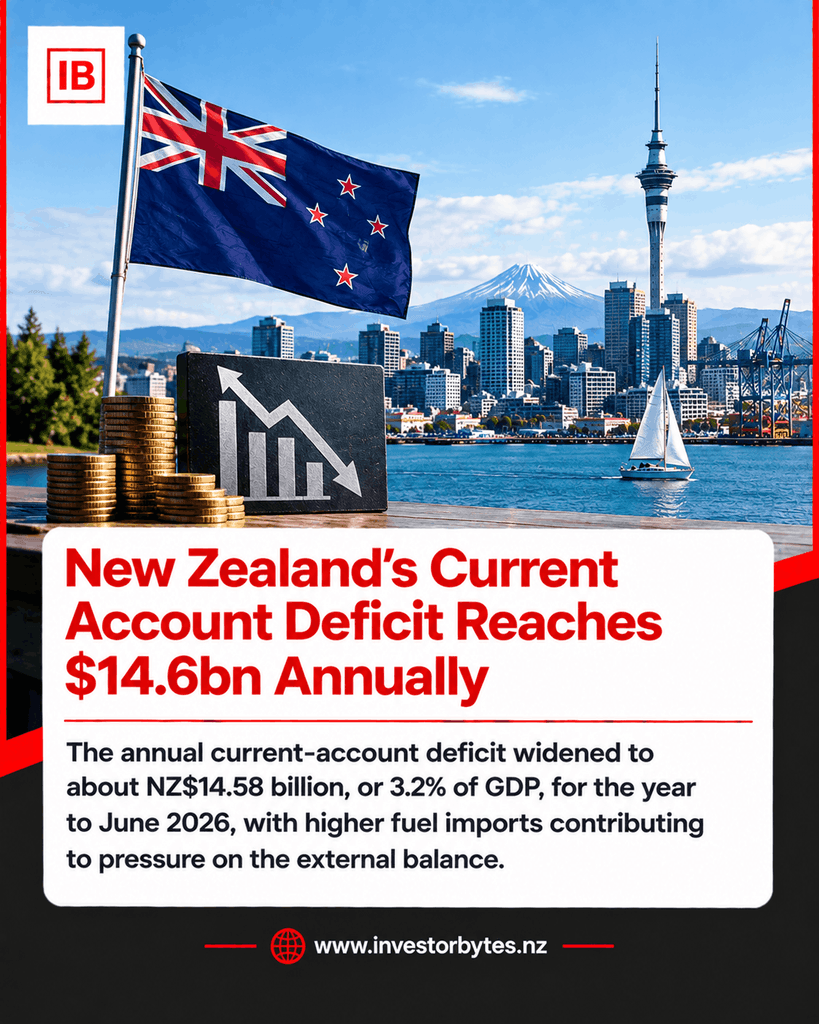
The New Zealand current account deficit reached about NZ$14.58 billion, equal to 3.2% of GDP, for the year to June 2026.
New Zealand Current Account Deficit Reaches $14.6 Billion
The New Zealand Current Account Deficit was about NZ$14.58 billion for the year to June 2026, equivalent to approximately 3.2% of GDP. The latest figure provides an important indicator of New Zealand’s external economic position.
The current account measures transactions between New Zealand and the rest of the world, including trade in goods and services, income flows and transfers.
What Is the New Zealand Current Account Deficit?
The New Zealand Current Account Deficit occurs when the value of transactions creating outflows to the rest of the world exceeds the value of corresponding inflows over the measured period.
A deficit can result from factors including goods trade, services trade, investment income and other international transactions.
The latest annual deficit was around NZ$14.58 billion.
3.2% of GDP
The New Zealand Current Account Deficit represented approximately 3.2% of GDP for the year to June 2026.
Looking at the deficit as a share of GDP helps provide context because a dollar amount alone does not show the size of the deficit relative to the economy.
A 3.2% figure therefore provides investors and economists with another way to monitor New Zealand’s external position.
Role of Fuel Imports
Higher fuel imports were identified as one factor contributing to pressure on the external balance in the figures supplied for this update.
Energy prices can have an impact on New Zealand’s trade position because imported fuel adds to the value of goods purchased from overseas.
Changes in global commodity prices can therefore influence the New Zealand Current Account Deficit.
Impact on the NZ Economy
The New Zealand Current Account Deficit is important because it provides information about the country’s international economic relationships.
A persistent deficit can reflect a combination of trade and investment-income factors.
For investors, the current account can also be considered alongside GDP growth, inflation, interest rates and the NZ Dollar.
Currency Connection
The New Zealand Current Account Deficit can also interact with currency markets.
Currency movements influence the cost of imports and the New Zealand-dollar value of exports and overseas income.
Conversely, international investors and capital flows can affect financial conditions and exchange-rate dynamics.
What Investors Should Watch
Investors following the New Zealand Current Account Deficit should monitor quarterly current-account releases, trade figures, fuel prices, export performance and international investment income.
The current-account position can change as commodity prices, tourism activity, domestic demand and global economic conditions change.
Conclusion
The New Zealand Current Account Deficit reached about NZ$14.58 billion for the year to June 2026, or approximately 3.2% of GDP.
The figure highlights the importance of monitoring New Zealand’s external balance and the factors affecting imports, exports and international income flows.
For investors, businesses and economists, the New Zealand Current Account Deficit remains an important indicator of the country’s external economic position
Stats NZ – Balance of Payments and International Investment Position: June 2026
The June 2026 data shows the annual current account deficit at NZ$14.6 billion, or 3.2% of GDP.