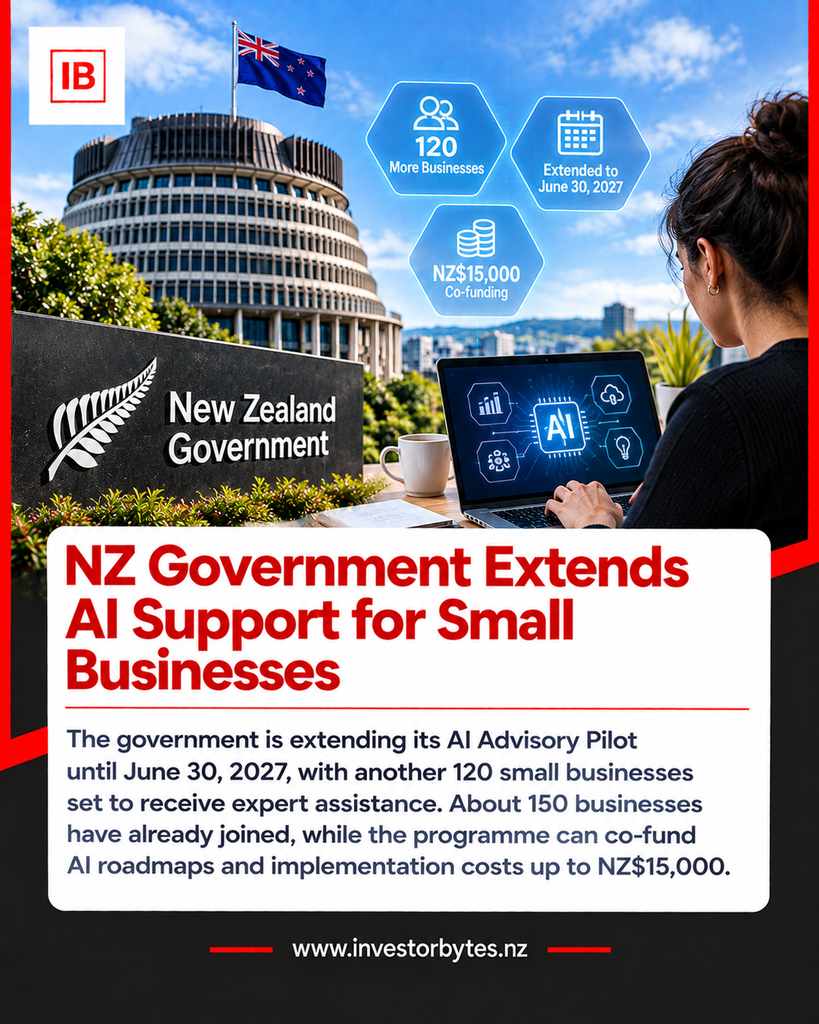
The NZ AI Advisory Pilot will be extended to June 2027, with another 120 small businesses set to receive expert assistance with AI adoption.
NZ AI Advisory Pilot: 5 Key Benefits for Small Businesses
The NZ AI Advisory Pilot is being extended to provide additional support for small businesses adopting artificial intelligence. The programme is scheduled to continue until 30 June 2027, with another 120 businesses expected to receive expert assistance. Around 150 businesses have already participated.
The expansion reflects the growing role of artificial intelligence in business operations. For small companies, access to expertise can be particularly important because many firms may not have dedicated technology teams.
What Is the NZ AI Advisory Pilot?
The NZ AI Advisory Pilot provides practical assistance to small businesses looking to understand and adopt AI.
The programme is delivered through the Regional Business Partner Network. Earlier programme information said eligible businesses could receive co-funding of up to 50 percent, with support of up to NZ$15,000 for expert assistance and implementation.
The objective is not simply to introduce AI tools but to help businesses identify practical applications.
More Businesses to Receive Support
The latest expansion means another 120 small businesses are expected to receive assistance.
Around 150 businesses have already participated, bringing the potential total supported through the pilot to approximately 270 businesses. The programme is scheduled to operate until 30 June 2027.
This extension gives more businesses time to assess where AI could be useful in their operations.
How AI Can Help Small Businesses
Artificial intelligence can be used across many business functions.
Examples include customer service, document processing, marketing, data analysis, administration, forecasting and workflow automation.
For a small business, even a relatively simple automation can reduce repetitive work and allow staff to focus on higher-value tasks.
However, identifying a useful application can be difficult without technical knowledge.
That is where advisory support can become important.
The Importance of Practical Implementation
The NZ AI Advisory Pilot focuses on practical business adoption rather than simply providing access to technology.
A company might have access to AI software but still struggle to identify the best use case.
For example, a retailer could use AI to analyse customer enquiries, while a professional-services business might use it to organise documents or improve internal workflows.
The appropriate application depends on the business.
AI and Productivity
Productivity is one of the major economic questions surrounding AI.
If businesses can produce more output with the same amount of labour and capital, productivity could improve.
For small businesses, productivity improvements can potentially come from reducing administrative workloads, improving decision-making and automating repetitive processes.
The economic effect will depend on whether businesses can successfully integrate AI into everyday operations.
Risks and Challenges
AI adoption also creates challenges.
Businesses need to consider data security, privacy, cybersecurity, accuracy and employee training.
AI-generated information can contain errors, so businesses need appropriate review processes.
There can also be costs associated with software, implementation and training.
The NZ AI Advisory Pilot can therefore be viewed as part of a broader effort to help smaller companies navigate these challenges.
What It Means for New Zealand Business
The extension of the programme highlights the increasing importance of AI adoption for New Zealand’s small-business sector.
With another 120 businesses expected to participate, the programme could provide additional examples of how AI is being used in real-world business environments.
For investors and business owners, the development is relevant because productivity and technology adoption can influence competitiveness and long-term growth.