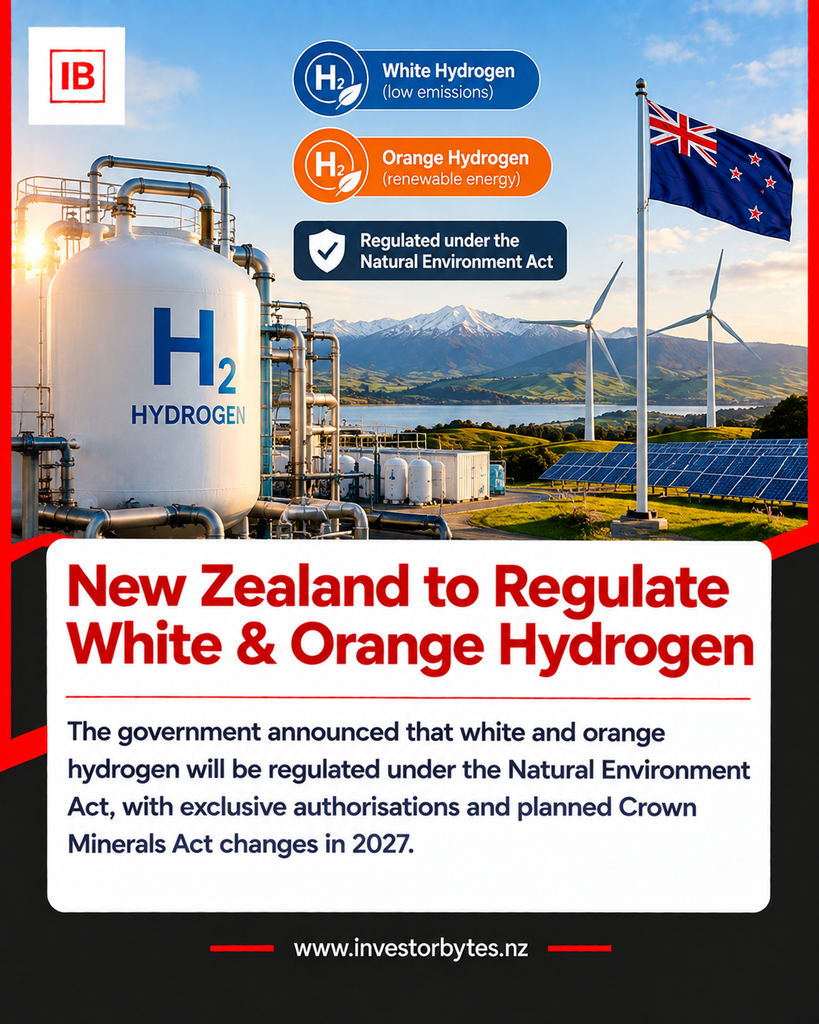
New Zealand will regulate white and orange hydrogen under its environmental framework, with further Crown Minerals Act changes planned for 2027.
New Zealand Moves to Regulate White and Orange Hydrogen
New Zealand is moving forward with a regulatory framework for white and orange hydrogen, creating a clearer pathway for the exploration and development of these emerging forms of naturally occurring hydrogen.
The Government has agreed that white and orange hydrogen will be regulated under the Natural Environment Act framework. Further changes to the Crown Minerals Act are also planned for 2027.
The announcement is relevant to New Zealand’s developing energy sector and could provide greater clarity for companies considering hydrogen exploration and investment.
White and Orange Hydrogen Regulation
The decision to regulate white and orange hydrogen is part of the Government’s broader approach to developing rules around emerging natural resources.
Under the announced framework, these hydrogen resources will be brought within the Natural Environment Act system.
The Government has also indicated that changes to the Crown Minerals Act are planned for 2027.
Together, the changes are intended to establish a clearer regulatory pathway for businesses interested in exploring and developing natural hydrogen resources.
What Is White Hydrogen?
White hydrogen generally refers to hydrogen that occurs naturally underground as a geological resource.
Unlike hydrogen produced through industrial processes, naturally occurring hydrogen can potentially be extracted directly from geological formations.
Interest in natural hydrogen has increased internationally as governments, researchers and energy companies examine alternative sources of hydrogen.
The development of a regulatory framework is therefore relevant to companies that may want to investigate New Zealand’s geological potential.
What Is Orange Hydrogen?
Orange hydrogen is another emerging area associated with geological processes that can produce hydrogen underground.
The sector is still developing, and commercial viability depends on factors such as geological conditions, exploration results, technology, infrastructure and production costs.
The regulatory framework does not by itself guarantee that commercial projects will be developed.
Instead, it establishes rules under which future exploration and development can take place.
Why White and Orange Hydrogen Matter
Hydrogen is increasingly being discussed as part of the future energy system.
Hydrogen can potentially be used in industrial processes, transport, energy storage and other applications.
New Zealand’s renewable electricity resources also provide an important background for the country’s wider hydrogen sector.
However, different hydrogen technologies have different production costs, infrastructure requirements and environmental characteristics.
Natural hydrogen represents one area that companies and researchers are increasingly examining.
Regulatory Certainty for Businesses
The Government has said the new framework is intended to provide greater certainty for businesses and investors interested in the sector.
Regulatory clarity can be important for resource companies because exploration projects often require significant investment before commercial resources can be confirmed.
Companies need to understand environmental requirements, approval processes and resource-access rules before committing significant capital.
The introduction of specific rules can therefore help businesses assess potential opportunities and risks.
Crown Minerals Act Changes
The planned 2027 Crown Minerals Act changes are another important part of the regulatory process.
The Crown Minerals Act provides a framework for managing certain mineral and petroleum resources in New Zealand.
Changes to that framework could influence how natural hydrogen resources are treated and how exploration and development activities are authorised.
The interaction between environmental regulation and resource legislation will therefore be important for companies following the sector.
Potential Investment Interest
The development of a regulatory framework could increase interest in natural hydrogen exploration.
Energy companies, geological researchers, technology businesses and investors may monitor future exploration opportunities.
However, investment decisions will depend on the results of geological surveys, resource estimates, extraction technology, infrastructure requirements and the economics of potential projects.
The regulatory announcement is therefore an early-stage development rather than evidence of commercial production.
New Zealand’s Emerging Hydrogen Sector
New Zealand is already examining hydrogen as part of its future energy and industrial strategy.
Hydrogen could potentially support sectors that are difficult to electrify directly.
Natural hydrogen adds another potential source to the country’s developing hydrogen landscape.
The regulation of white and orange hydrogen could therefore provide a foundation for further exploration and research.
Outlook for White and Orange Hydrogen
The new framework marks an important step in establishing rules for white and orange hydrogen in New Zealand.
The next stages will include further regulatory development and the planned Crown Minerals Act changes in 2027.
For businesses, energy companies and investors, future exploration results and regulatory details will be important factors to monitor.
The commercial potential of natural hydrogen will ultimately depend on whether suitable resources can be identified and developed economically.
https://nz.investorbytes.com/wp-admin/post.php?post=26031&action=edit
The New Zealand Government has agreed to regulate white and orange hydrogen through the Natural Environment Act framework, with further Crown Minerals Act changes planned for 2027. Read the New Zealand Government’s announcement on white and orange hydrogen regulation.