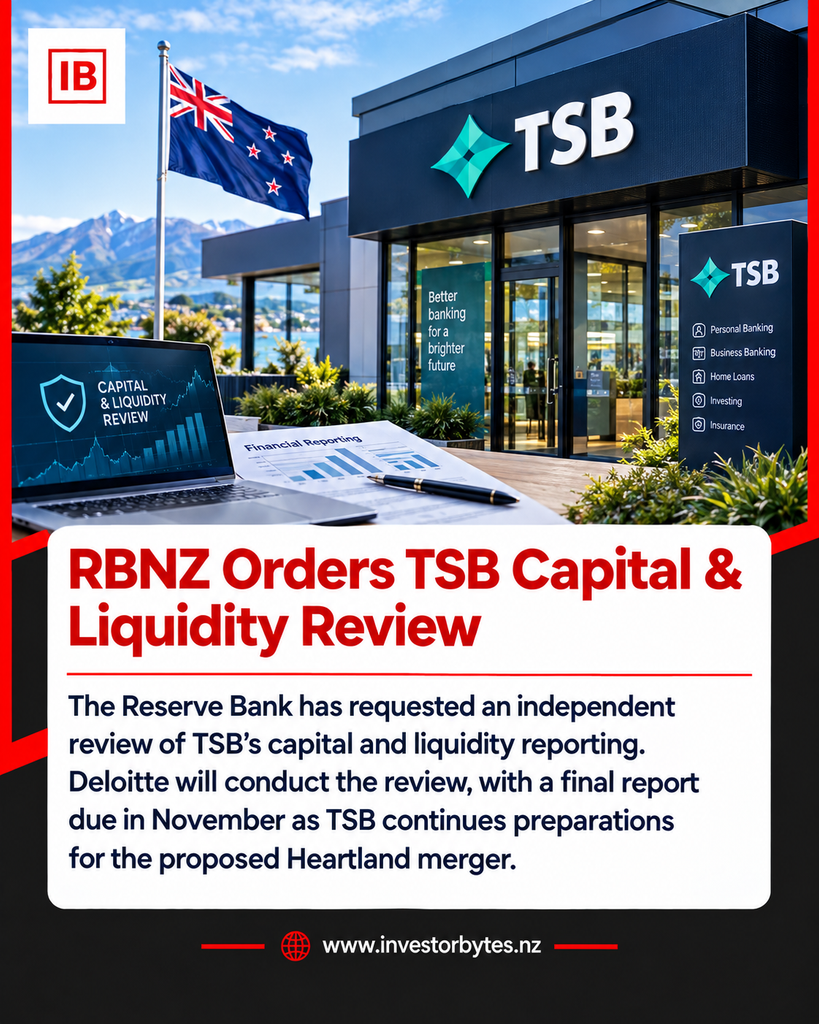
The RBNZ has requested an independent TSB capital review covering aspects of capital and liquidity ratio calculation and reporting.
TSB Capital Review Ordered by RBNZ as Bank Prepares for Proposed Merger
The Reserve Bank of New Zealand has requested an independent report into aspects of TSB Bank’s capital and liquidity reporting, creating a significant regulatory development for New Zealand’s banking sector. The TSB capital review will be conducted by Deloitte, with a final report due to the Reserve Bank in November 2026.
The Reserve Bank issued the request under Section 95 of the Banking (Prudential Supervision) Act 1989. Under this provision, the regulator can require a bank to provide a report prepared by an independent person approved by the Reserve Bank.
Why the TSB Capital Review Matters
Capital and liquidity are central components of banking regulation.
A bank needs sufficient capital to absorb losses and maintain financial resilience, while liquidity helps ensure that it can meet its obligations as they become due. Banks therefore report various capital and liquidity ratios to their regulator.
According to the Reserve Bank, TSB itself identified and reported issues concerning aspects of the computation and reporting of its capital and liquidity ratios. The TSB capital review is intended to provide independent assurance and insight into the bank’s systems and practices.
TSB has appointed Deloitte to undertake the independent work.
The Reserve Bank has said the matter remains an ongoing prudential issue and that it cannot provide further comment while the review is underway.
TSB and the Proposed Heartland Transaction
The timing of the TSB capital review is also notable because TSB is involved in a proposed transaction with Heartland Group Holdings.
Interest.co.nz reported that Heartland has proposed acquiring TSB and combining the businesses, subject to the relevant approvals and conditions. The proposed transaction has attracted attention across New Zealand’s banking sector because it would reshape the ownership and structure of the two banking businesses.
The independent review does not itself establish that TSB is undercapitalised or experiencing a liquidity problem.
TSB has indicated that its current liquidity and funding positions remain sound and that the bank remains well capitalised, according to reporting on the matter.
This distinction is important when assessing the TSB capital review. A regulatory review into reporting and calculation does not automatically mean that a bank lacks financial strength.
What Capital and Liquidity Ratios Tell Investors
Capital ratios provide information about a bank’s ability to absorb losses relative to its risk-weighted assets.
Liquidity measures provide information about a bank’s ability to meet short-term obligations and withstand funding pressures.
These measures are particularly important because banks operate with substantial leverage and depend on confidence from depositors, wholesale funding markets and other financial institutions.
For investors and customers, the TSB capital review therefore highlights the importance of accurate regulatory reporting.
Even where an underlying bank remains financially sound, accurate calculation and reporting are essential for regulators, investors and other stakeholders to understand the institution’s financial position.
Deloitte’s Role
Deloitte has been appointed to conduct the independent report.
The review is expected to provide the Reserve Bank with additional information about the issues identified by TSB. The final report is due in November.
Until that process is complete, it is important to distinguish confirmed information from potential outcomes. The Reserve Bank has not publicly stated that the issues identified represent a broader solvency or liquidity problem.
The TSB capital review is therefore best understood as a supervisory process designed to provide additional assurance.
Implications for the Banking Sector
The development highlights the broader role of prudential supervision in New Zealand.
Banks are required to maintain systems capable of accurately measuring financial risks and reporting information to the regulator. Independent reviews can provide additional assurance where a regulator considers further investigation appropriate.
For the wider banking sector, the TSB capital review demonstrates how reporting standards, internal controls and regulatory oversight remain important even when a bank is continuing normal operations.
The proposed Heartland transaction adds another layer of relevance because regulatory approvals and conditions are part of the process surrounding significant banking transactions.
What Happens Next?
The immediate next step is the independent review by Deloitte.
The Reserve Bank is expected to receive the final report in November. Until then, additional conclusions about the significance of the reporting issues would be premature.
Investors and banking-sector observers will therefore be watching for the findings of the TSB capital review, alongside developments relating to the proposed Heartland transaction.
The case illustrates why prudential supervision matters for New Zealand’s financial system. Accurate capital and liquidity information allows regulators to monitor banks and respond to potential issues while there is still time to address them.
External Links
Reserve Bank of New Zealand — TSB independent report
Interest.co.nz — TSB capital and liquidity review
https://nz.investorbytes.com/wp-admin/post.php?post=26062&action=edit