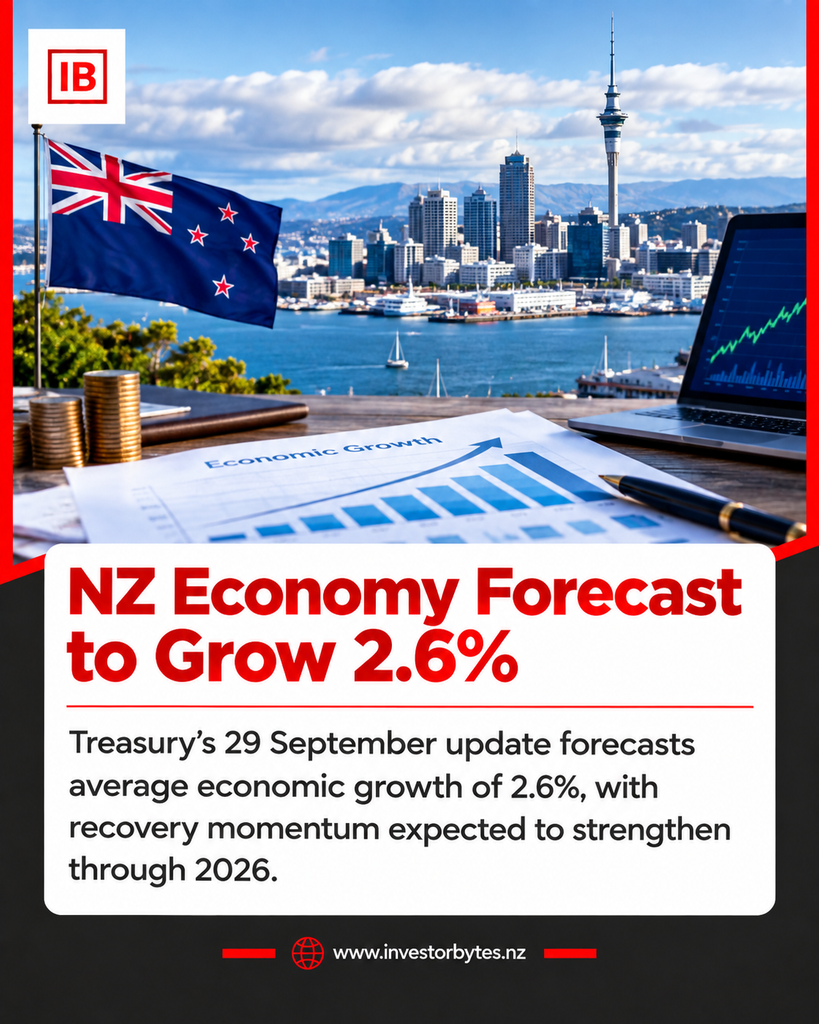
NZ economy forecast to grow 2.6% on average as Treasury expects stronger activity, employment and wages. Explore 7 key economic signals and risks.
Table of Contents
- NZ Economy Forecast to Grow 2.6%
- Treasury’s Economic Outlook
- Growth Recovery
- Employment and Wages
- Inflation and Interest Rates
- Exports and External Demand
- Risks to Economic Growth
- Business and Investment Implications
- Conclusion
NZ Economy Forecast to Grow 2.6%
The NZ economy forecast to grow 2.6% is one of the headline economic projections contained in New Zealand Treasury’s Pre-election Economic and Fiscal Update released on 29 September 2026. Treasury expects economic activity to strengthen after a period of weak growth, with improving household incomes, employment and business activity supporting the recovery.
The forecast provides an updated picture of New Zealand’s economic direction at a time when global conditions remain uncertain.
Treasury expects real production GDP to accelerate from 1.6% in the year to June 2026 to 2.3% in 2027 and 2.9% in 2028. Growth then remains around the mid-2% range through the remainder of the forecast period.
Treasury’s Economic Outlook
The Treasury expects the economic recovery to regain momentum during the second half of 2026.
The forecast is based on several factors, including resilient external demand, an improving terms of trade and easing inflation pressures.
Treasury also expects domestic demand to gradually contribute more to growth. Household consumption, business investment and hiring are expected to become more important as the recovery becomes more established.
This transition is important because an economy relying on several sources of growth may be less dependent on any single component of demand.
Growth Recovery
New Zealand experienced a difficult economic period before the latest recovery.
Treasury’s figures show real production GDP contracted by 1.1% in the year to June 2025. Growth is forecast to return to positive territory, reaching 1.6% in 2026 and accelerating to 2.9% in 2028.
The forecast suggests the economy is moving from a weak-growth environment toward more normal expansion.
However, the path is unlikely to be uniform. Quarterly economic activity can be affected by global commodity prices, interest rates, weather conditions, household spending and international trade.
Employment and Wages
Employment is an important part of the NZ economy forecast to grow 2.6% outlook.
Treasury forecasts approximately 220,000 additional jobs over the forecast period. It also expects wages to increase faster than prices.
The unemployment rate is forecast to peak at around 5.6% before gradually declining to 4.3% by the end of the forecast period.
Improving employment can support household income and consumer demand. However, the pace of improvement will depend on how quickly businesses increase hiring.
Inflation and Interest Rates
Inflation remains an important part of the economic outlook.
Treasury forecasts consumer price inflation at 4.1% in the June 2026 quarter, followed by a decline toward 2% over the forecast period.
A decline in inflation could improve real household incomes and reduce pressure on interest rates.
However, higher energy prices remain a potential threat to that trajectory. Treasury specifically identifies the oil-price shock as a major near-term uncertainty.
Exports and External Demand
New Zealand is highly dependent on international trade.
Treasury expects resilient external demand and an improving terms of trade to support export growth and national income.
Export-oriented industries such as agriculture, food production, tourism and other internationally exposed sectors can therefore play an important role in the recovery.
Global demand, commodity prices and exchange rates will remain important variables for New Zealand exporters.
Risks to Economic Growth
The NZ economy forecast to grow 2.6% should not be interpreted as a certainty.
Treasury identifies risks surrounding oil prices, inflation, interest rates, productivity, migration and the terms of trade.
If energy prices remain high, inflation could remain elevated for longer. Higher interest rates could then reduce household spending and business investment.
Global trade conditions also matter because New Zealand’s economy is strongly connected to overseas markets.
Business and Investment Implications
Businesses may benefit from stronger economic activity if consumer demand and employment improve.
For investors, the economic growth outlook can affect expectations for corporate earnings, interest rates, the New Zealand dollar and equity markets.
However, economic growth alone does not determine market performance. Company earnings, valuations, global conditions and monetary policy can also influence asset prices.
Conclusion
The NZ economy forecast to grow 2.6% provides a central part of Treasury’s latest economic outlook.
The forecast points toward stronger growth, rising employment and improving household income conditions. At the same time, inflation, oil prices and global uncertainty remain important risks.
The next phase of New Zealand’s recovery will therefore depend not only on headline GDP growth but also on how employment, inflation, investment and external demand develop.
External source: New Zealand Treasury – Pre-election Economic and Fiscal Update 2026
https://nz.investorbytes.com/wp-admin/post.php?post=26117&action=edit