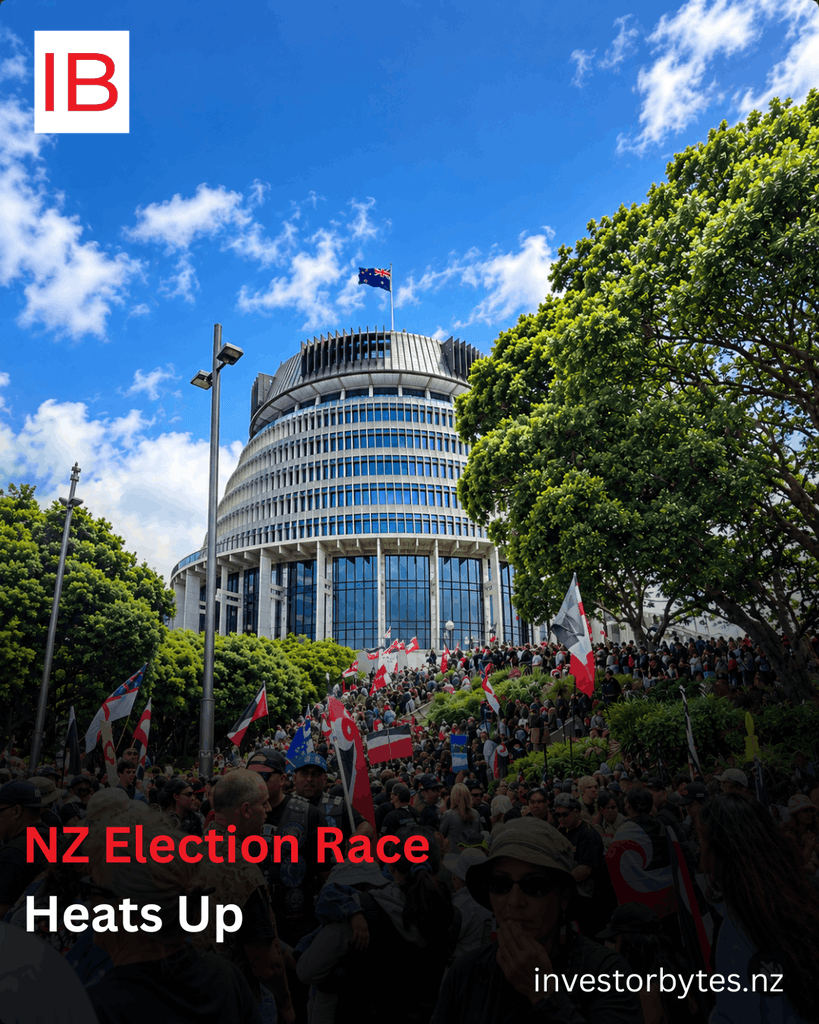
The New Zealand election race is heating up as Labour, National and the Greens shift in the latest poll. Discover 5 key trends to watch.
New Zealand Election: 5 Major Warning Signs as Race Heats Up
The New Zealand election is becoming an increasingly important political and economic story as the country moves closer to the 2026 general election. A new RNZ-Reid Research poll has put Labour at 30.8%, National at 25.9% and the Green Party at 14.8%, highlighting significant movement among voters.
With the New Zealand election scheduled for November 7, the latest polling numbers are attracting attention not only from political observers but also from businesses, investors and financial markets. The changing support levels could influence expectations around economic policy, taxation, government spending, regulation and investment.
The latest figures should be viewed as a snapshot of voter sentiment rather than a prediction of the final election result. Polling can change before election day, particularly when several parties are competing under New Zealand’s proportional representation system.
Table of Contents
- Why the New Zealand Election Is Getting Attention
- Latest New Zealand Election Poll Numbers
- National Party Support Falls
- Labour Leads the Latest Poll
- Greens Gain Ground
- Why Smaller Parties Matter
- New Zealand Election and the Economy
- What Investors Should Watch
- Conclusion
Why the New Zealand Election Is Getting Attention
The New Zealand election matters because political changes can affect the direction of economic policy. Businesses and investors often monitor elections for potential changes involving taxes, government expenditure, infrastructure, regulation, trade and monetary-policy institutions.
The latest poll arrives at a time when New Zealand’s economy is also receiving significant attention. The country’s business confidence has improved, while inflation, interest rates, fuel costs and global geopolitical risks remain important issues for companies and households. Reuters reported that New Zealand business confidence strengthened significantly during the third quarter, although economic uncertainty remained.
That means the New Zealand election is taking place against an economic backdrop that could make financial policy particularly important.
For businesses, election uncertainty can affect investment decisions. Companies may delay major projects until there is greater clarity about future policy. Investors can also watch sectors such as infrastructure, energy, technology, housing and financial services for possible policy changes.
Latest New Zealand Election Poll Numbers
The latest RNZ-Reid Research poll shows Labour on 30.8%, National on 25.9% and the Greens on 14.8%. New Zealand First recorded 10.6%, ACT 9%, the Opportunity Party 5.5% and Te Pāti Māori 2%.
National’s 25.9% result represents its lowest support level in this polling series since the 2020 general election, according to reporting on the poll. Labour also declined compared with earlier levels, while the Greens recorded a notable increase.
These numbers demonstrate why the New Zealand election is receiving increased attention. Rather than one or two parties dominating the political conversation, several parties could have an important role in determining the composition of the next government.
It is important to remember that a poll does not determine the election result. Polls measure the opinions of respondents at a particular point in time and can change as campaigns develop.
National Party Support Falls
National’s latest polling number of 25.9% is one of the most notable developments in the current New Zealand election campaign. Reuters reported that National’s support had fallen to its weakest level since the 2020 election.
For the governing party, polling movement can create pressure to focus on issues that matter most to voters.
Economic management is likely to remain a central issue. Cost-of-living pressures, employment, government spending, infrastructure and taxation can all influence voter sentiment.
From an investment perspective, investors will also be interested in whether political parties maintain or change existing economic settings.
Policy stability is particularly important for businesses making long-term investment decisions. Changes in taxation, regulation or government priorities can influence expected returns on major projects.
Labour Leads the Latest Poll
Labour recorded 30.8% in the latest poll, putting it ahead of National in the reported party vote figures.
The Labour result is significant because economic policy is likely to be one of the major themes during the New Zealand election campaign.
Issues such as household costs, employment, healthcare, public services and economic growth can all become part of the political debate.
For investors, the key point is not simply which party is leading a particular poll. Instead, markets will be watching the policies presented by each major party and how those proposals could affect businesses and financial conditions.
Investors should therefore avoid treating a single polling result as an election forecast.
Greens Gain Ground
The Green Party has recorded 14.8% in the latest RNZ-Reid Research poll, according to reports.
The increase is important because smaller parties can have considerable influence in New Zealand’s proportional electoral system.
Environmental policy, climate investment, public transport, housing and social policy are among the areas that can affect business planning and investment decisions.
For companies operating in energy, infrastructure, transport and technology, environmental policy can be particularly relevant.
The growing importance of smaller parties means the New Zealand election cannot be analysed solely through the performance of Labour and National.
Why Smaller Parties Matter
New Zealand uses a proportional representation system, meaning smaller parties can play an important role in determining the composition of Parliament.
The latest poll puts New Zealand First at 10.6%, ACT at 9% and the Opportunity Party at 5.5%.
The Opportunity Party’s result is particularly notable because it is above the 5% party-vote threshold cited in reporting on the poll.
This makes smaller parties an important part of the New Zealand election discussion.
For financial markets, coalition negotiations can matter because investors often want to understand which policies are likely to become government policy.
New Zealand Election and the Economy
The New Zealand election is taking place alongside important economic developments.
The Treasury released the 2026 Pre-election Economic and Fiscal Update on September 29. The update provides forecasts covering New Zealand’s economic and fiscal outlook and outlines risks facing the country over the forecast period.
That makes the economic outlook an important part of the election discussion.
Businesses may be watching government spending, borrowing, taxation, infrastructure investment and economic growth.
Investors may also monitor how election-related uncertainty affects the New Zealand dollar, equity markets and business confidence.
The Reserve Bank’s interest-rate decisions will remain another important factor. Monetary policy is separate from election polling, but economic conditions can influence the political environment.
What Investors Should Watch
There are several areas investors should monitor as the New Zealand election approaches.
1. Tax Policy
Changes to corporate, personal or investment taxation can affect expected returns and business decisions.
2. Government Spending
Infrastructure and public-sector spending can influence construction, engineering, technology and other industries.
3. Regulation
Changes to business regulation can affect operating costs and investment decisions.
4. Trade Policy
New Zealand’s international trade relationships remain important for exporters and companies exposed to global markets.
5. Economic Stability
Investors will continue watching inflation, interest rates, employment and GDP growth alongside the political campaign.
Conclusion
The New Zealand election is entering an important phase, with the latest RNZ-Reid Research poll showing Labour at 30.8%, National at 25.9% and the Greens at 14.8%.
The figures demonstrate changing voter sentiment, but they should not be treated as a prediction of the final election result.
For businesses and investors, the bigger question is how the campaign develops and what economic policies emerge from the competing parties.
With the election scheduled for November 7, political developments, economic data and policy announcements are likely to remain closely watched in the weeks ahead.
The New Zealand election is therefore not only a political story. It is also an economic story with potential implications for businesses, investors, government spending, taxation and regulation.