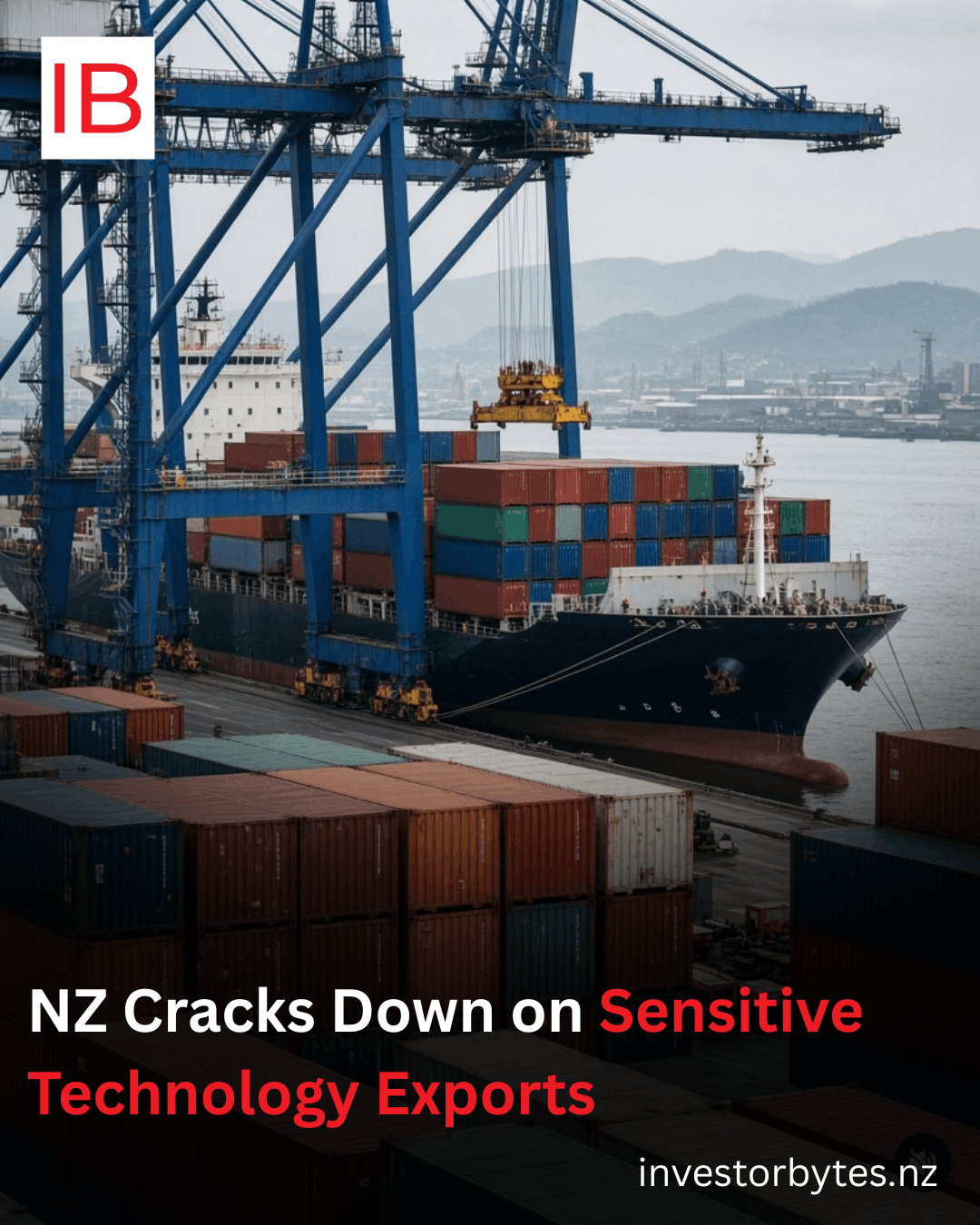
New Zealand technology exports face tighter scrutiny after 9,098 integrated circuits were stopped. Learn what the crackdown means for exporters.
Table of Contents
- What Is Happening With New Zealand Technology Exports?
- 9,098 Integrated Circuits Stopped
- Why Integrated Circuits Can Be Sensitive
- What Are Dual-Use Technologies?
- Singapore and Hong Kong Shipments
- NZ$18,720 Fine for Export Breaches
- Why Export Controls Matter
- What New Zealand Exporters Need to Know
- Impact on NZ Technology Trade
- What Investors Should Watch
- Conclusion
What Is Happening With New Zealand Technology Exports?
New Zealand technology exports are facing increased scrutiny as Customs strengthens enforcement around sensitive electronic components and dual-use technologies.
The issue gained attention after New Zealand Customs announced that a local electronics company had been fined following attempts to export thousands of integrated circuits without notifying the Ministry of Foreign Affairs and Trade.
Customs said the company attempted to export 9,098 integrated circuits, or ICs, without the required notification. The components were seized before they could leave New Zealand.
The case highlights the importance of export compliance for companies involved in electronics, semiconductors and other advanced technologies.
It also demonstrates how New Zealand technology exports can intersect with national security and international trade controls.
9,098 Integrated Circuits Stopped
The central issue involved 9,098 integrated circuits.
According to New Zealand Customs, APVM Electronics Private Limited faced two charges in the Manukau District Court on 1 October 2026 after failing to notify MFAT before attempting to export the components.
The first shipment involved 9,000 integrated circuits intended for an entity in Singapore.
A second shipment involved 98 integrated circuits intended for an entity in Hong Kong.
Customs said both shipments were stopped during its investigation before the goods could be exported.
The case is significant because integrated circuits are widely used in ordinary commercial products, but certain types can also have military applications.
That dual-use characteristic is central to the regulatory challenge.
Why Integrated Circuits Can Be Sensitive
Integrated circuits are essential components in modern technology.
They are used in:
- Computers
- Smartphones
- Communications equipment
- Consumer electronics
- Industrial equipment
- Automotive systems
- Aerospace technology
Most ICs have completely legitimate commercial applications.
However, Customs explained that some integrated circuits can also be incorporated into drones, weapons-guidance systems and missile technology. These are considered examples of dual-use applications.
This creates a challenge for regulators.
A component that appears to be an ordinary electronic product could potentially have a different application depending on its technical specifications and end user.
That is why certain New Zealand technology exports can require additional scrutiny.
What Are Dual-Use Technologies?
Dual-use technologies are products, software or technology that can have both civilian and military applications.
For example, advanced electronics may be used in commercial communications systems while similar technology could also be incorporated into defence equipment.
New Zealand Customs states that the export of controlled military and dual-use goods, software and technology requires approval from the Ministry of Foreign Affairs and Trade.
This means exporters cannot simply assume that a product is unrestricted because it has a commercial use.
Businesses need to determine whether their products fall under relevant export controls.
For companies involved in New Zealand technology exports, this can make product classification and compliance particularly important.
Singapore and Hong Kong Shipments
The case involved two separate attempted shipments.
On 7 March 2025, APVM Electronics attempted to export 9,000 integrated circuits to an entity in Singapore without notifying MFAT.
On 31 March 2025, the company attempted to export another 98 ICs to an entity in Hong Kong without the required notification.
The components were seized during the Customs investigation.
The destinations are significant because New Zealand’s export-control system requires exporters to consider not only the product itself but also the circumstances surrounding an international shipment.
For technology businesses, understanding the destination, recipient and end use can therefore be an important part of compliance.
NZ$18,720 Fine for Export Breaches
The company was fined NZ$18,720 following the Customs investigation.
The case demonstrates that export-control violations can have direct financial consequences for businesses.
However, the potential impact can extend beyond a fine.
Companies involved in international technology trade may also face:
- Shipment delays
- Seizures
- Additional compliance costs
- Reputational damage
- Customer uncertainty
- Regulatory investigations
For businesses involved in New Zealand technology exports, these risks make compliance an important part of international trade planning.
A strong export-control process can help companies identify potential problems before goods reach the border.
Why Export Controls Matter
Export controls are designed to prevent sensitive goods and technology from reaching inappropriate end users or being used for prohibited purposes.
New Zealand Customs says export clearance helps ensure that prohibited items do not leave the country, restricted goods have the correct permits and overseas trading partners can have confidence in the security of New Zealand exports.
This has a broader economic significance.
New Zealand relies heavily on international trade.
If trading partners have confidence in the country’s export-control system, New Zealand companies can operate within a more trusted international trading environment.
The challenge is to maintain effective controls without unnecessarily slowing legitimate trade.
What New Zealand Exporters Need to Know
Companies involved in New Zealand technology exports should take several compliance steps.
1. Classify products correctly
Businesses need to understand exactly what technology they are exporting.
2. Check whether approval is required
Some restricted or dual-use goods require approval before export.
3. Understand the end user
Exporters should know who will receive the goods and how they are intended to be used.
4. Review the destination
Different destinations can create different compliance considerations.
5. Keep accurate records
Businesses should maintain documentation showing what was exported and why.
6. Use professional advice when necessary
Complex technology exports may require advice from Customs, MFAT or qualified trade specialists.
7. Complete export clearance
New Zealand Customs states that goods generally require electronic export clearance before leaving the country, with exceptions for some postal items.
Impact on NZ Technology Trade
The increased focus on New Zealand technology exports comes as advanced technology becomes more important to global trade.
Semiconductors and electronic components are strategically important because they underpin modern industries.
Governments around the world are increasingly paying attention to technology supply chains and the movement of advanced components.
For New Zealand businesses, this could mean greater compliance requirements when dealing with sensitive technology.
However, stronger controls could also support New Zealand’s reputation as a trusted trading partner.
Companies that develop strong compliance systems may be better positioned to operate internationally.
What Investors Should Watch
Investors following New Zealand’s technology sector should watch several trends.
Export-control compliance
Technology companies may face additional costs when dealing with regulated products.
Semiconductor demand
Global demand for chips remains important to electronics, artificial intelligence, communications and advanced manufacturing.
International trade relationships
New Zealand’s technology businesses depend on access to international markets.
Regulatory risk
Companies that fail to understand export restrictions could face financial and reputational consequences.
Advanced technology investment
Greater focus on technology security could increase demand for compliant supply chains and specialist technologies.
Conclusion
The latest case involving 9,098 integrated circuits highlights the growing importance of export controls for New Zealand technology exports.
New Zealand Customs said APVM Electronics was fined NZ$18,720 after attempting to export the components without notifying MFAT. The shipments involved 9,000 ICs destined for Singapore and another 98 destined for Hong Kong.
The case also highlights why dual-use technology requires careful oversight. While integrated circuits are essential to everyday consumer and commercial technology, some can also have military applications.
For New Zealand exporters, the message is clear: understanding export restrictions, product classifications, end users and required approvals is essential.
For investors, the development is another indication that technology trade is increasingly connected to national security and international regulatory policy.
As advanced technology becomes more strategically important, New Zealand technology exports are likely to receive continued attention from regulators, businesses and investors.
External Links
- New Zealand Customs Service — Sensitive Technology Export Case
- New Zealand Customs — Export Prohibitions and Restrictions
- New Zealand Customs — Clear Your Exports
- New Zealand Ministry of Foreign Affairs and Trade
https://nz.investorbytes.com/wp-admin/post.php?post=26155&action=edit