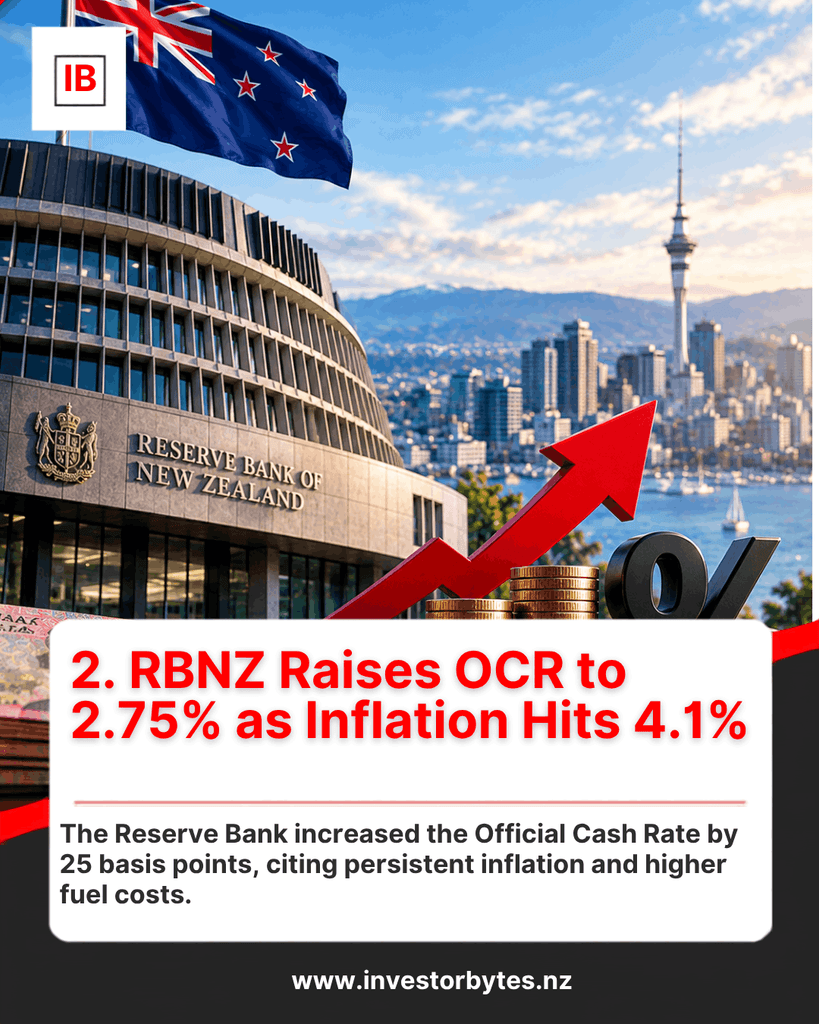
RBNZ Official Cash Rate rises to 2.75% after a 25-basis-point hike as New Zealand inflation reaches 4.1% due largely to higher fuel prices
RBNZ Official Cash Rate Rises to 2.75%
The RBNZ Official Cash Rate was increased by 25 basis points to 2.75% on September 2, 2026, as the Reserve Bank of New Zealand (RBNZ) responded to renewed inflation pressure. The increase was the second consecutive rate hike, with annual inflation reaching 4.1% in the June quarter, largely reflecting higher fuel and related prices.
The central bank said monetary policy would continue to focus on returning inflation sustainably to its 2% midpoint while supporting economic growth and employment.
5 Key Changes Behind the RBNZ Official Cash Rate Decision
1. OCR Increases by 25 Basis Points
The RBNZ raised its policy rate from 2.50% to 2.75%.
The Monetary Policy Committee reached the decision by consensus and said the increase was appropriate for bringing inflation back toward the 2% midpoint.
The decision followed another 25-basis-point increase in July, making this the second consecutive meeting at which the central bank raised borrowing costs.
2. Inflation Reaches 4.1%
New Zealand’s annual consumer inflation increased to 4.1% in the June 2026 quarter, above the RBNZ’s 1–3% target range.
The central bank attributed much of the increase to higher fuel prices arising from the conflict in the Middle East. However, inflation excluding vehicle fuels was 2.9%, while most measures of core inflation remained within the target range.
This distinction is important because the RBNZ is also monitoring underlying and forward-looking inflation pressures rather than responding only to temporary fuel-price movements.
3. Fuel Costs Add to Inflation Pressure
Higher energy prices have become an important factor in New Zealand’s inflation outlook.
The RBNZ said elevated and volatile energy and petrochemical-derived prices had increased inflation in New Zealand and its trading partners. Global supply chains, refining capacity and trade flows have also been disrupted.
For households and businesses, higher fuel prices can raise transportation and operating costs, potentially affecting prices across other parts of the economy.
4. Economic Recovery Remains Uneven
While inflation remains elevated, the RBNZ also noted that New Zealand’s economic recovery is beginning to resume.
The central bank said the recovery was expected to strengthen and become broader, supported by resilient demand from trading partners and strong export prices. However, weak income growth, job insecurity and flat house prices continued to weigh on household spending and residential investment.
More recent GDP data showed the economy grew 0.2% in Q2 2026, beating the 0.1% market forecast, while annual growth reached 2.6%. Construction increased 2.7% and was the largest upward contributor.
5. Further OCR Increases Remain Possible
The RBNZ did not commit to a fixed future rate path.
The central bank said the OCR may need to increase further, but emphasized that future decisions will depend on the balance of medium-term inflation risks. It described the process of removing monetary stimulus as gradual.
The RBNZ’s projections indicated inflation should return to the 1–3% target band by mid-2027 and reach the 2% midpoint later in 2027, assuming the economic outlook develops as expected.
What the RBNZ Official Cash Rate Means for Borrowers
Changes to the RBNZ Official Cash Rate can influence borrowing costs throughout New Zealand’s financial system.
Higher policy rates can affect mortgage rates, business lending and other forms of borrowing. This can increase financing costs for households and companies, potentially reducing spending and investment.
At the same time, higher rates can help moderate demand and inflation by making borrowing more expensive.
Impact on Businesses and Investors
Businesses with significant borrowing requirements may face higher financing costs when interest rates rise. Property-related businesses can also be sensitive to changes in borrowing conditions.
For investors, the OCR is an important factor when assessing New Zealand banks, property markets, bonds, equities and the New Zealand dollar.
The impact is not uniform across asset classes, however, and depends on inflation expectations, economic growth, earnings and global financial conditions.
Inflation Outlook Remains Central
The RBNZ’s decision reflects the challenge of dealing with inflation while the economy is still recovering.
The central bank expects inflation to remain elevated in the near term before declining as the effects of higher fuel prices fade. It also noted that longer-term inflation expectations remain close to 2%, while expected wage growth is consistent with inflation returning toward target.
The next policy decisions will therefore depend heavily on incoming inflation, employment, economic-growth and global energy data.
Key Takeaways
- The RBNZ Official Cash Rate increased by 25 basis points to 2.75%.
- The September increase was the second consecutive rate hike.
- Annual inflation reached 4.1% in Q2 2026.
- Higher fuel prices were a major contributor to the inflation increase.
- Inflation excluding vehicle fuels was 2.9%.
- The RBNZ expects inflation to return to its 1–3% target range by mid-2027.
- Further OCR increases remain possible, but future decisions are not predetermined.
- New Zealand’s economic recovery is continuing but remains uneven.
Conclusion
The latest RBNZ Official Cash Rate decision highlights the central bank’s response to inflation that remains above its target range. Raising the OCR to 2.75% increases monetary restraint while the economy continues its gradual recovery.
Higher fuel prices remain an important source of inflation pressure, but the RBNZ has also pointed to relatively contained core inflation and longer-term expectations. Future policy will therefore depend on whether inflation pressures become more persistent and how economic activity develops.
For investors and businesses, the OCR, inflation, fuel prices and GDP growth will remain key indicators for assessing New Zealand’s financial and economic environment.