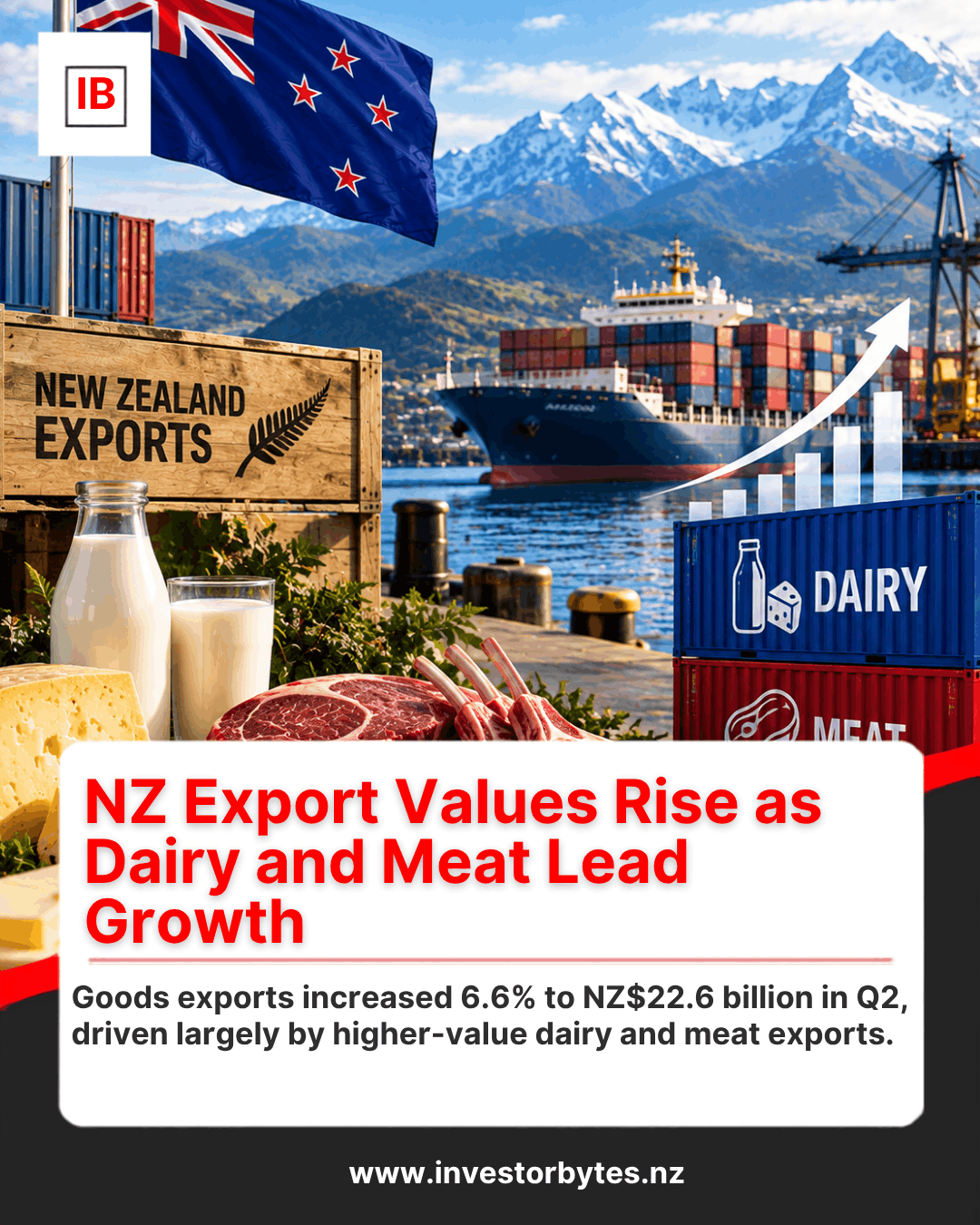
New Zealand Export Values increased 6.6% to NZ$22.6 billion in Q2 2026, with dairy and meat products leading the rise in goods exports.
New Zealand Export Values Rise in Q2 2026
New Zealand Export Values increased strongly in the June 2026 quarter, supported by higher-value dairy and meat exports. According to Stats NZ, seasonally adjusted goods exports rose NZ$1.4 billion, or 6.6%, to NZ$22.6 billion in Q2 2026.
The increase came alongside higher goods imports, but stronger exports helped offset part of the pressure created by the country’s larger import bill.
1. Goods Exports Reach NZ$22.6 Billion
The biggest change in New Zealand Export Values was the NZ$1.4 billion quarterly increase.
Goods exports reached NZ$22.6 billion in the June 2026 quarter, compared with the previous quarter. Stats NZ identified dairy and meat as the main contributors to the increase.
The result highlights the continued importance of New Zealand’s primary industries to the country’s international trade performance.
For investors and businesses, export growth can provide an important indicator of overseas demand and the earnings generated by major export industries.
2. Dairy Products Lead Export Growth
Dairy was one of the key sectors behind the increase in New Zealand Export Values.
New Zealand remains heavily connected to international dairy markets, with dairy products forming an important part of merchandise export earnings. Higher export values can reflect stronger global demand, improved prices, increased volumes, or a combination of these factors.
The latest quarterly data therefore provides a positive signal for businesses exposed to New Zealand’s dairy supply chain.
However, future export performance will continue to depend on global commodity prices, demand from major trading partners and currency movements.
3. Meat Exports Also Support Growth
Meat products were another major contributor to the increase in goods exports during Q2.
The rise in meat export values added to the broader improvement in merchandise trade and helped lift total exports to NZ$22.6 billion.
Meat is another important component of New Zealand’s primary-sector economy. Changes in international prices and demand can therefore have wider implications for agricultural incomes, rural businesses and related industries.
The combination of stronger dairy and meat values shows that primary products were central to the quarter’s export performance.
4. Export Growth Helps Offset Higher Imports
The improvement in New Zealand Export Values came at a time when imports were also rising.
Goods imports increased NZ$1.8 billion, or 8.2%, to NZ$24.1 billion, mainly because of higher petroleum and petroleum-product import values. Higher diesel, petrol and jet fuel prices contributed to the increase.
Because imports increased by more in dollar terms than exports, New Zealand’s seasonally adjusted goods deficit widened to NZ$1.5 billion, from NZ$1.1 billion in the March quarter.
This means stronger exports did not fully offset the higher cost of imported goods.
5. Services Trade Also Improves
The wider trade picture received additional support from the services sector.
New Zealand’s seasonally adjusted services balance moved into a NZ$183 million surplus in the June quarter, compared with a NZ$117 million deficit in March. Services exports increased NZ$193 million to NZ$9.4 billion, while services imports declined NZ$107 million to NZ$9.2 billion.
The improvement in both goods exports and services trade contributed to a more balanced external position, although the overall current account remained in deficit.
Key Takeaways
- New Zealand Export Values rose 6.6% in Q2 2026.
- Goods exports increased by NZ$1.4 billion to NZ$22.6 billion.
- Dairy and meat were the leading contributors to export growth.
- Goods imports increased faster, reaching NZ$24.1 billion.
- The services balance moved into a NZ$183 million surplus.
What Stronger Exports Mean for New Zealand
Higher export values can support national income by increasing foreign earnings from New Zealand’s major export industries.
The latest figures are particularly relevant for agricultural businesses, exporters, logistics companies and investors exposed to commodity markets. Strong dairy and meat values can support farm revenues and related economic activity, although the ultimate impact depends on prices, volumes, exchange rates and production costs.
At the same time, the higher import bill shows that export growth alone does not determine New Zealand’s external trade position. Energy prices remain an important factor because higher fuel costs can increase the cost of transporting goods and operating businesses.
Outlook for New Zealand Trade
The direction of global commodity prices will remain important for future New Zealand Export Values.
Dairy and meat demand, international food prices, exchange-rate movements and economic conditions in major trading partners could all influence export earnings in coming quarters.
Businesses will also be watching energy prices because a sustained increase in fuel costs could continue to raise import expenses and put pressure on the goods trade balance.
Conclusion
New Zealand Export Values increased significantly in the June 2026 quarter, with goods exports rising 6.6% to NZ$22.6 billion. Dairy and meat products were the leading contributors, highlighting the continued importance of New Zealand’s primary industries.
Although stronger exports provided support, imports increased by an even larger amount, largely because of higher petroleum costs. The improvement in services trade nevertheless added another positive element to New Zealand’s external accounts.