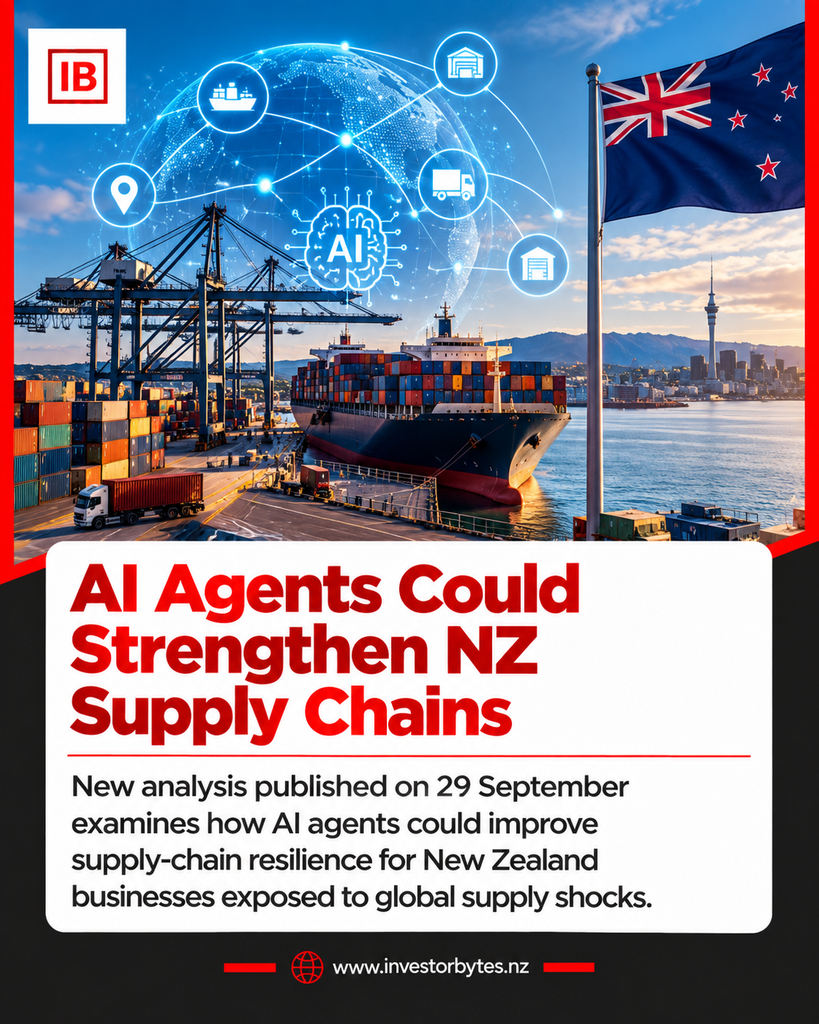
AI agents could strengthen NZ supply chains by improving procurement, supplier monitoring and resilience against global disruptions, new analysis finds.
Table of Contents
- AI Agents Could Strengthen NZ Supply Chains
- Why NZ Supply Chains Are Vulnerable
- From Chatbots to AI Agents
- Procurement and Supplier Management
- Faster Risk Detection
- Barriers to AI Adoption
- Opportunities for NZ Businesses
- Supply-Chain Resilience
- Conclusion
AI Agents Could Strengthen NZ Supply Chains
AI Agents Could Strengthen NZ Supply Chains is the focus of new analysis published by the University of Auckland on 29 September 2026.
The analysis examines whether agentic artificial intelligence could make New Zealand supply chains more resilient by helping businesses monitor suppliers, identify risks and respond faster to disruptions.
The issue is particularly relevant to New Zealand because the country is geographically distant from many major markets and depends heavily on international trade.
Why NZ Supply Chains Are Vulnerable
New Zealand businesses have faced repeated international supply-chain disruptions in recent years.
The University of Auckland analysis points to disruptions associated with the COVID-19 pandemic, the Suez Canal blockage, Red Sea disruptions and more recent shipping pressures.
The analysis notes that New Zealand has approximately NZ$80 billion of annual exports, making efficient supply chains important to the wider economy.
From Chatbots to AI Agents
The AI Agents Could Strengthen NZ Supply Chains concept differs from traditional chatbot technology.
AI agents can perform multi-step tasks rather than simply responding to individual questions.
In procurement, agents could help discover suppliers, evaluate tenders, analyse contracts, monitor supplier performance and identify potential risks.
The University of Auckland analysis describes these systems as capable of deciding, acting and adjusting their actions under human supervision.
Procurement and Supplier Management
Procurement is particularly important for supply-chain resilience.
Businesses need to know which suppliers they depend on, what alternatives exist and how quickly they can switch when a supplier or transport route becomes unavailable.
AI systems could help automate parts of that process.
For example, a monitoring system could continuously review supplier information, shipping data and other sources for warning signs.
Faster Risk Detection
One potential benefit is speed.
The University of Auckland analysis says a risk-monitoring AI agent could scan shipping information, news and supplier registers continuously, potentially reducing risk-detection time.
Supplier-discovery systems could also help businesses identify alternative suppliers more quickly.
For smaller New Zealand businesses, this could be particularly relevant because they may not have large procurement teams.
Barriers to AI Adoption
The AI Agents Could Strengthen NZ Supply Chains story also includes significant challenges.
The University of Auckland analysis identifies fragmented data, outdated software and governance issues as barriers.
It reports that 71% of surveyed respondents identified trust in autonomous decision-making as a barrier, alongside security, regulatory uncertainty, accountability and auditability.
These issues matter because businesses need confidence that AI systems are making appropriate recommendations and that human oversight remains effective.
Opportunities for NZ Businesses
AI could potentially help smaller businesses access capabilities previously associated with larger organisations.
A small procurement team could use AI tools to monitor a larger number of suppliers and analyse more information.
However, adopting the technology is not simply a matter of purchasing software.
Businesses also need suitable data, governance systems and employees who understand how AI tools operate.
Supply-Chain Resilience
The AI Agents Could Strengthen NZ Supply Chains analysis argues that companies should consider procurement as a strategic resilience function rather than simply an administrative process.
This approach is relevant because New Zealand’s geographic distance can make disruptions more expensive and time-consuming.
Faster identification of alternative suppliers could potentially reduce the impact of shipping delays or supplier failures.
Conclusion
The AI Agents Could Strengthen NZ Supply Chains story highlights a growing connection between artificial intelligence and economic resilience.
AI agents could potentially improve supplier discovery, procurement monitoring and disruption response.
However, data quality, security, governance, accountability and trust remain significant challenges.
For New Zealand businesses, the technology may provide opportunities to strengthen procurement capabilities, but successful implementation will depend on appropriate human oversight and business processes.
External source: University of Auckland – How AI agents might bolster NZ’s supply chains
https://nz.investorbytes.com/wp-admin/post.php?post=26114&action=edit