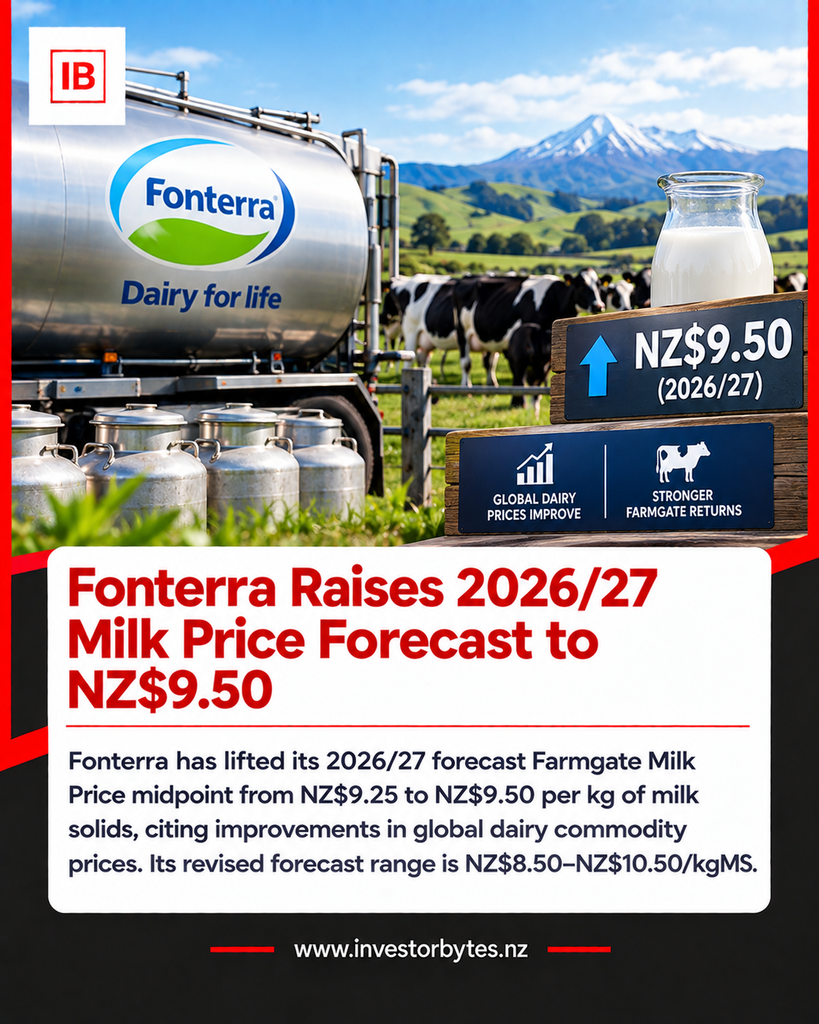
Fonterra raises its 2026/27 milk price forecast to NZ$9.50 per kgMS as global dairy commodity prices improve and demand remains strong.
Fonterra Milk Price Forecast 2026/27: NZ$9.50 Explained
The Fonterra milk price forecast 2026/27 has been increased to NZ$9.50 per kilogram of milk solids, reflecting recent improvements in global dairy commodity prices. Fonterra announced the revised forecast on 21 September 2026, lifting the midpoint from NZ$9.25 per kgMS.
The change is significant for New Zealand’s dairy sector because the farmgate milk price is an important indicator of potential income for dairy farmers. Dairy exports also form an important part of New Zealand’s wider trade economy.
Fonterra Raises the Forecast
Fonterra increased its 2026/27 Farmgate Milk Price midpoint from NZ$9.25 to NZ$9.50 per kgMS.
The company also narrowed its forecast range. The previous range of NZ$8.00 to NZ$10.50 per kgMS was changed to NZ$8.50 to NZ$10.50 per kgMS.
The revision follows an earlier reduction in July, when Fonterra moved its forecast down to NZ$9.25 after weaker Global Dairy Trade auction results.
The latest increase therefore represents a change in the direction of the forecast as global dairy conditions have improved.
Global Dairy Commodity Prices
Fonterra said the latest revision was supported by improvements in global commodity prices.
The company specifically highlighted Global Dairy Trade auction results for key products, including whole milk powder and skim milk powder. Fonterra also said global demand remained strong.
Global dairy prices are important because New Zealand exports a large share of its dairy production.
When international prices improve, the potential value of exported dairy products can increase. This can support farm incomes and contribute to activity across the agricultural supply chain.
Impact on New Zealand Farmers
For dairy farmers, the Fonterra milk price forecast 2026/27 provides an important reference point for planning.
A higher forecast can affect expectations around farm revenue, operating expenditure, debt servicing and capital investment.
However, the forecast is not a guaranteed final payment. Dairy prices can change throughout the season because of international supply and demand, currency movements, weather conditions and geopolitical developments.
Fonterra itself has maintained a cautious approach because the season remains relatively early.
Impact on the New Zealand Economy
The dairy sector has a broader impact on the New Zealand economy.
Higher dairy export values can support rural communities, transport companies, processors, manufacturers and other businesses connected to agriculture.
Dairy exports also generate foreign exchange earnings, making global commodity prices relevant to the country’s trade position.
The sector’s performance can therefore influence economic activity beyond individual farms.
Currency and Dairy Exports
The New Zealand dollar is another important factor for dairy exporters.
Global dairy products are sold internationally, while many farm and processing costs are incurred in New Zealand dollars. Changes in the NZD can therefore affect the New Zealand-dollar value of international sales.
This means investors and businesses often monitor both commodity prices and currency movements when assessing the outlook for the agricultural sector.
What Investors Should Watch
The Fonterra milk price forecast 2026/27 will likely remain sensitive to Global Dairy Trade auction results, international demand, production trends and geopolitical conditions.
Fonterra has already noted that only a relatively short part of the new season has passed and that conditions can change.
The revised NZ$9.50 midpoint is therefore an important update, but it should be viewed as a forecast rather than a final outcome.
For New Zealand’s agricultural economy, the combination of global dairy prices, production conditions and currency movements will remain important throughout the season.