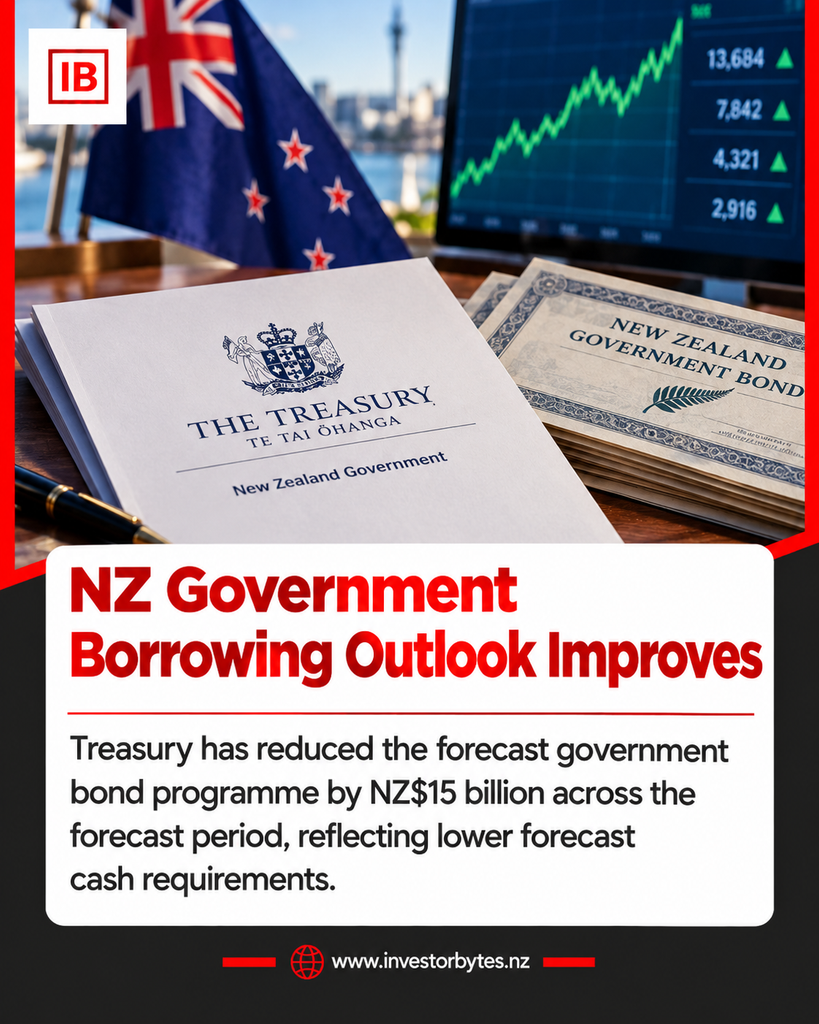
Government borrowing outlook improves as New Zealand Treasury cuts planned bond issuance by NZ$15 billion across the forecast period.
Table of Contents
- Government Borrowing Outlook Improves
- NZ$15 Billion Reduction
- New Zealand Government Bond Programme
- Why Borrowing Has Changed
- Debt and GDP
- Interest Costs
- Risks to the Borrowing Outlook
- Market Implications
- Conclusion
Government Borrowing Outlook Improves
The government borrowing outlook improves after New Zealand Treasury announced a reduction in its forecast government bond programme on 29 September 2026.
The Treasury’s debt-management office said the forecast New Zealand Government Bond programme has been reduced by NZ$15 billion across the forecast period compared with the Budget Economic and Fiscal Update 2026.
The change reflects lower forecast cash requirements following the latest fiscal update.
NZ$15 Billion Reduction
The reduction is spread across several years.
The forecast 2026/27 New Zealand Government Bond programme has been reduced to NZ$30 billion, which is NZ$4 billion lower than previously forecast.
The 2027/28 and 2028/29 programmes have each been reduced by NZ$4 billion, while the 2029/30 programme has been reduced by NZ$3 billion.
A new NZ$25 billion bond programme has also been added for 2030/31.
New Zealand Government Bond Programme
Government bonds are an important part of public-sector financing.
When government spending exceeds revenue, borrowing can help fund the difference.
The Treasury’s latest update suggests that the government will need to borrow less than previously anticipated.
Short-term borrowing is also forecast to be lower. Treasury Bills and Euro-Commercial Paper at the end of 2026/27 are forecast at NZ$10 billion, which is NZ$5 billion lower than the previous forecast.
Why Borrowing Has Changed
The improved borrowing outlook is linked to the wider fiscal update.
Treasury expects higher tax revenue and stronger economic activity to improve the government’s financial position.
Core Crown tax revenue has been revised up by NZ$11.4 billion across four comparable forecast years.
Higher revenue reduces the amount the government needs to finance through debt issuance.
Debt and GDP
Although borrowing requirements have been reduced, New Zealand’s debt position remains important.
Net core Crown debt is forecast to increase from NZ$186.7 billion in 2026 to around NZ$232.8 billion in 2030 before falling to NZ$229.8 billion in 2031.
As a percentage of GDP, net core Crown debt is forecast to peak at around 43.9% in 2028.
This distinction is important. A reduction in new borrowing does not necessarily mean the total debt balance immediately declines.
Interest Costs
Lower borrowing can also affect government finance costs.
Treasury says stronger revenue reduces government borrowing, with net finance costs revised down by NZ$1.7 billion despite higher market interest rates.
Interest costs are an important part of fiscal planning because higher rates can increase the cost of servicing existing and new debt.
Risks to the Borrowing Outlook
The government borrowing outlook improves based on current Treasury forecasts, but future borrowing can change.
If economic growth is weaker than expected, tax revenue may decline.
If inflation or interest rates remain higher, debt-servicing costs could increase.
Energy prices and global economic conditions can also affect government revenue and spending.
Market Implications
Government borrowing requirements are closely watched by financial markets.
Bond investors monitor government issuance because changes in supply can affect government bond markets.
Lower borrowing requirements can also affect expectations around public-sector financing costs.
For businesses and investors, the Treasury update therefore provides information beyond government accounts. It also offers insight into the broader financial environment.
Conclusion
The government borrowing outlook improves after Treasury reduced its planned bond programme by NZ$15 billion across the forecast period.
The change reflects improved fiscal projections and lower expected cash requirements.
However, New Zealand’s total debt remains substantial, and future borrowing will depend on economic growth, tax revenue, interest rates and government spending.
External source: New Zealand Debt Management – PREFU 2026 Bond Programme Update
https://nz.investorbytes.com/wp-admin/post.php?post=26117&action=edit