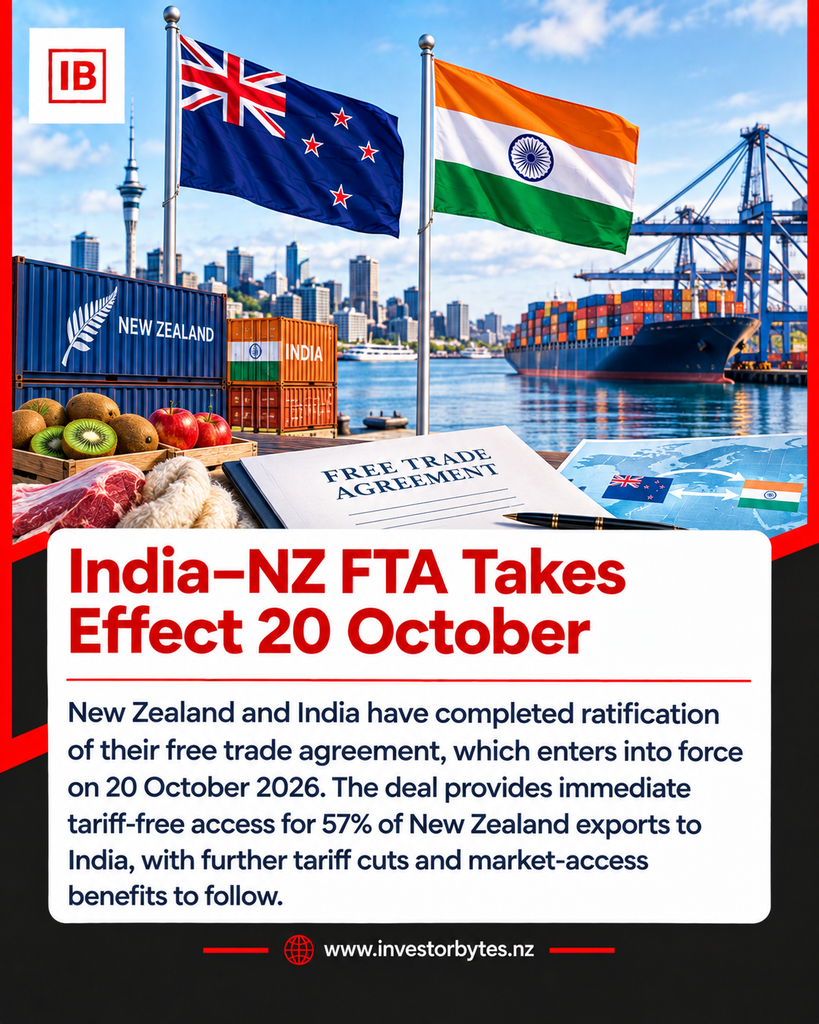
The India-NZ FTA enters into force on 20 October 2026, creating expanded market access and tariff benefits for New Zealand exporters.
The India-NZ FTA is scheduled to enter into force on 20 October 2026 after New Zealand and India completed ratification of the agreement.
The agreement represents a significant development in New Zealand’s trade relationship with one of the world’s largest economies and is expected to create expanded market-access opportunities for exporters and service providers.
New Zealand’s Ministry of Foreign Affairs and Trade says the agreement will provide preferential access for 95% of New Zealand’s current exports to India over time.
What the India–NZ FTA Provides
The India–NZ FTA provides tariff preferences across a range of New Zealand goods.
According to MFAT, 57% of New Zealand’s current exports to India will receive full tariff elimination immediately from entry into force, rising to 82% over time, with further tariff reductions applying to another 13%.
This means the agreement will not deliver every tariff reduction immediately.
Instead, different products have different implementation schedules.
For exporters, understanding these schedules will be important when calculating future landed costs and pricing strategies.
Forestry and Agricultural Products
Forestry is one of the areas receiving significant benefits under the India–NZ FTA.
MFAT says more than 95% of New Zealand forestry exports to India will be able to enter tariff-free immediately, with tariffs on almost all existing trade phased out over seven years.
The agreement also provides new opportunities for horticultural products.
Kiwifruit and apples receive new quota access, while tariffs on products such as cherries, avocados, blueberries and persimmons will be phased down.
For New Zealand agricultural exporters, these provisions could provide additional opportunities to expand sales in India.
Dairy and Food Products
The India–NZ FTA also contains provisions affecting dairy-related products.
Tariffs on bulk infant formula and other dairy-based preparations will be phased out over seven years, while some dairy-related products will receive quota-based treatment.
The agreement also establishes a fast-track mechanism relating to New Zealand dairy products used in India for further manufacturing and export.
These provisions could be relevant for New Zealand companies looking to participate in Indian supply chains rather than simply selling finished products directly to consumers.
Services and Investment
The India–NZ FTA goes beyond goods.
The agreement includes services commitments covering sectors such as engineering, environmental services and education.
Financial services and telecommunications are also covered through dedicated provisions.
This is important because modern trade increasingly includes digital services, professional services, investment and cross-border business activity.
The agreement also establishes cooperation around investment promotion and includes commitments designed to support greater two-way investment.
Why India Matters to New Zealand
MFAT says India was New Zealand’s 11th-largest goods and services export market in the year ended December 2025, with total exports of approximately NZ$2.03 billion.
That position indicates there is considerable room for trade expansion if businesses can successfully use the new market access created by the India–NZ FTA.
India’s large population and expanding middle class provide a potentially significant market for New Zealand products and services.
However, businesses will still need to understand local competition, consumer preferences, distribution systems and regulatory requirements.
Trade Diversification
The India–NZ FTA also has broader significance for New Zealand’s export diversification strategy.
New Zealand has historically maintained strong trade relationships across Asia-Pacific markets, particularly China and Australia.
Expanding commercial relationships with India can add another major destination for New Zealand exporters.
The goal does not necessarily have to be replacing existing markets. Instead, businesses can use improved market access to build additional revenue channels.
What Happens Next?
The agreement is scheduled to enter into force on 20 October 2026.
Businesses will need to understand the rules of origin, tariff schedules, customs procedures and documentation requirements relevant to their products.
MFAT says the agreement includes rules designed to make customs procedures more predictable and supports electronic systems and paperless trade.
The India–NZ FTA therefore represents more than a headline tariff agreement. Its long-term effect will depend on how effectively businesses use the provisions and build commercial relationships in India.
External Links
MFAT — New Zealand–India FTA Overview
MFAT — India–NZ FTA Key Outcomes
https://nz.investorbytes.com/wp-admin/post.php?post=26062&action=edit