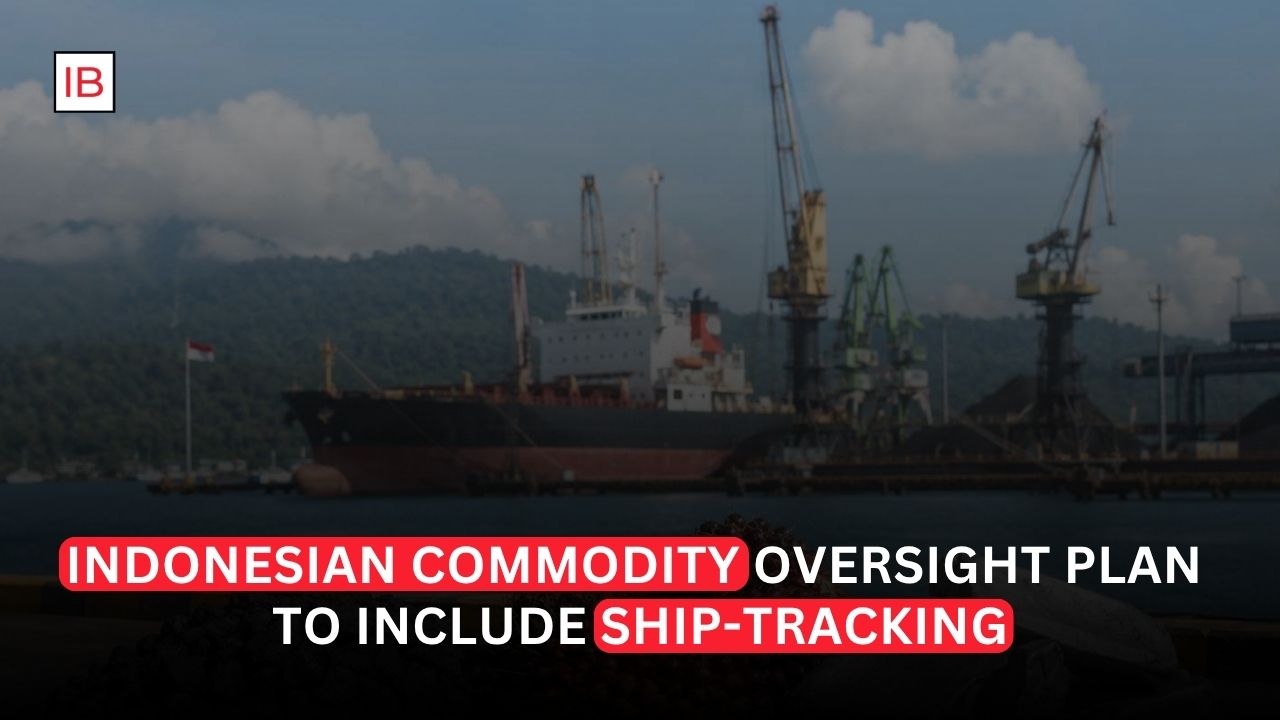
Indonesia is moving to strengthen oversight of its strategic commodity exports, with ship tracking expected to become part of a broader system designed to improve transparency, prevent revenue leakage and give the government greater visibility over the movement and value of commodities leaving the country.
The initiative comes as Jakarta reshapes an earlier proposal to centralize strategic commodity exports through a state-linked entity. Instead of becoming a single state trading gatekeeper, the government is increasingly emphasizing monitoring and supervision while allowing existing exporters and trading arrangements to continue.
The change matters because commodities such as coal, palm oil and ferroalloys are major contributors to Indonesia’s export earnings. The government wants to capture more of the value generated by those resources without disrupting the private companies and international buyers that depend on Indonesian supplies.
Why Indonesia Is Tightening Commodity Oversight
Indonesia is one of the world’s most important commodity exporters.
Coal, palm oil and other natural resources generate substantial foreign-exchange earnings and support millions of jobs across mining, agriculture, logistics and related industries.
But the government has long faced concerns that some exporters may understate the value or volume of shipments.
If a shipment is declared at a lower value than its true market value, the government can potentially lose tax and export-related revenue.
That makes export monitoring a fiscal issue as well as a trade issue.
Indonesia’s new framework is designed to improve the government’s ability to determine what is being exported, where it is going and what the shipment is actually worth.
Ship Tracking Adds a New Layer of Visibility
The proposed use of ship tracking is particularly important because physical cargo movements can provide an independent source of information.
A government does not necessarily have to rely entirely on information submitted by an exporter.
By monitoring vessels, authorities can potentially establish:
- Where a ship departed from
- Which port it visited
- Where it ultimately arrived
- How long it remained in port
- Whether its movements match reported transactions
- Whether declared shipment information appears consistent with actual activity
That data could then be compared with customs declarations, invoices and other export documentation.
The objective is not necessarily to stop ships or interfere with normal trade.
Instead, the technology can help authorities identify transactions that deserve additional scrutiny.
Indonesia Is Moving Away From Full Export Centralization
The development is significant because Indonesia previously considered a much more interventionist model.
The government had planned to give a state-linked entity a central role in overseas sales of strategic commodities including coal, palm oil and ferroalloys.
That proposal caused concern among exporters, traders and investors because of the possibility that the state could effectively become the dominant gatekeeper for major commodity exports.
The government has since moved toward a monitoring-focused approach.
That reduces the risk of disrupting existing commercial relationships while still giving Jakarta greater oversight.
It is a compromise between state control and market freedom.
Danantara Sumberdaya Indonesia Has a Role
A central part of the government’s strategy is PT Danantara Sumberdaya Indonesia, known as DSI.
The government initially positioned DSI as a one-stop state export entity for strategic natural resources.
Official government information said DSI would help strengthen export supervision, improve trade transparency and optimize the management of export proceeds.
More recent developments suggest that its role is increasingly focused on oversight rather than directly taking control of commodity trading.
That distinction is important for investors.
A state entity that monitors markets is very different from a state entity that controls who can sell commodities and to whom.
Coal Is a Major Focus
Coal is likely to be one of the most important commodities affected by the new oversight framework.
Indonesia is a major coal exporter, supplying power stations and industrial users across Asia.
Because coal shipments are typically large and transported by sea, vessel tracking can provide useful information about actual export flows.
Authorities can compare ship movements with declared cargo information and export documentation.
This could help identify discrepancies between what is reported and what physically moves through Indonesian ports.
For the government, that creates an opportunity to reduce revenue leakage.
For exporters, it means greater scrutiny.
Palm Oil Presents a Different Challenge
Palm oil is another major Indonesian export, but its supply chain is more complex.
The industry involves plantations, mills, processors, traders, shipping companies and international buyers.
The government is already regulating strategic palm-oil exports under a separate framework.
Indonesia’s Trade Ministry has rules covering palm-oil derivative exports, export approvals, reporting and administrative sanctions.
Adding more comprehensive monitoring could make it easier to compare production, processing and export data.
That could improve the government’s ability to understand how much commodity is actually leaving the country and at what value.
The Bigger Problem Is Under-Invoicing
The most important issue behind the policy is not necessarily smuggling.
It is under-invoicing.
Under-invoicing occurs when an exporter declares a shipment at a value below its actual value.
If taxes, duties or other obligations depend on the declared value, this can reduce government revenue.
It can also distort official trade statistics.
Indonesia has been particularly concerned about the possibility of large-scale economic leakage from natural-resource exports.
Recent reporting has highlighted estimates that historical export under-invoicing may have resulted in enormous losses over several decades.
That helps explain why Jakarta is investing in stronger monitoring.
Technology Could Make Enforcement More Effective
Ship tracking is only one part of a larger digital system.
The government can potentially combine vessel data with:
- Customs records
- Export permits
- Port information
- Tax records
- Commodity prices
- Shipping documents
- Foreign trade data
- Company ownership information
The real value comes from combining these datasets.
For example, if a company’s declared export value is significantly below the expected international market price while its vessel movements confirm a large shipment, authorities could flag the transaction.
That is much more powerful than relying on individual inspections.
The Policy Could Improve Indonesia’s Revenue
If the system works, Indonesia could potentially collect more revenue without increasing tax rates.
That is attractive to the government.
Instead of asking companies and consumers to pay more, Jakarta can attempt to recover money that should already belong to the state.
Additional export revenue could support infrastructure, public services and other government priorities.
It could also strengthen Indonesia’s foreign-exchange position.
Investors Have Reason to Watch Carefully
The policy is not risk-free.
Investors are particularly sensitive to government interventions that could change how commodities are traded.
If oversight becomes excessive, exporters could face higher administrative costs and slower transactions.
International buyers could become less willing to sign long-term contracts if they fear unpredictable government intervention.
That could ultimately reduce investment in Indonesia’s resource sector.
The government therefore needs to demonstrate that monitoring does not become an indirect form of market control.
The Difference Between Monitoring and Control
This is the key issue.
A monitoring system can improve transparency while preserving competition.
A centralized export system can potentially give the government significant control over prices, buyers and commercial relationships.
Indonesia appears increasingly interested in the first model.
That could reassure businesses.
Recent reporting indicates that authorities are scaling back the original centralization proposal and instead tightening monitoring to address under-declaration and revenue losses.
Existing Contracts Need Protection
Another important consideration is whether existing export contracts will remain secure.
Commodity trading often involves long-term agreements between producers and international buyers.
Sudden changes to export procedures can create uncertainty over pricing, delivery schedules and contractual obligations.
Indonesia’s government has previously emphasized that the implementation of the new framework should not disrupt existing contracts or the physical flow of exports.
That assurance will be important for international investors.
Indonesia Wants More Value From Its Resources
The policy is also part of a broader economic strategy.
Indonesia has increasingly sought to capture more value from its natural resources rather than simply exporting raw materials.
That strategy includes downstream processing, domestic industrial development and tighter control over export proceeds.
The government says the strategic commodity framework is intended to support domestic supply stability, economic resilience, increased value-added production and national development.
Ship tracking fits naturally into that broader strategy because it gives the government more information about the physical movement of resources.
China and Other Asian Buyers Will Be Watching
Indonesia’s commodity policies have international consequences.
China, India, Japan, South Korea and other Asian economies depend heavily on Indonesian commodities.
Any major change in Indonesia’s export procedures could therefore affect international supply chains.
Coal buyers, palm-oil importers and commodity traders will want to know whether the new system increases costs or simply improves documentation.
If implementation is smooth, the policy could actually make Indonesian commodities more attractive by increasing confidence in export data.
Transparency Could Strengthen Indonesia’s Reputation
There is a potential upside for the private sector.
Greater transparency can reduce uncertainty.
If buyers know that Indonesian export volumes and values are being independently monitored, they may have greater confidence in official data.
That can make commodity markets more credible.
For a country that wants to attract international investment while maintaining strong state oversight of natural resources, that credibility matters.
But Implementation Will Be the Real Test
Indonesia already has rules governing strategic commodity exports.
The challenge is enforcement.
A sophisticated monitoring system will only work if government agencies can share information efficiently and investigate suspicious transactions.
It will also need strong safeguards against corruption.
If tracking data is available but enforcement remains inconsistent, the system may not produce the expected benefits.
The government will therefore need both technology and institutional capacity.
What Could Change for Exporters?
Exporters are likely to face more reporting requirements and greater scrutiny.
Companies with clean documentation should have relatively little to fear.
But businesses that rely on opaque pricing arrangements or complicated trading structures may face greater challenges.
The government could also use the system to identify unusual differences between declared prices and international benchmarks.
That would make accurate reporting more important than ever.
The Broader Economic Impact
Indonesia’s commodity sector is large enough that better oversight could have macroeconomic consequences.
More accurately reported export values could increase government revenue.
Better monitoring of export proceeds could strengthen foreign-exchange liquidity.
Improved data could also help policymakers understand the real performance of the resource sector.
In theory, that could lead to better economic planning.
The danger is that excessive intervention could have the opposite effect by discouraging private investment.
The balance will therefore be crucial.
Conclusion
Indonesia’s plan to incorporate ship tracking into commodity oversight reflects a broader shift in how Jakarta wants to manage its natural-resource wealth.
The government is trying to address a legitimate problem: ensuring that the country receives the revenue it is entitled to from major exports such as coal, palm oil and ferroalloys.
The earlier idea of centralized state control generated concerns among exporters and investors, and Jakarta now appears to be moving toward a more measured model focused on monitoring rather than directly controlling every transaction.
Ship tracking could become an important tool in that strategy.
By comparing vessel movements with customs declarations, export permits and transaction data, authorities could identify inconsistencies that are difficult to detect through paperwork alone.
But technology will not determine whether the policy succeeds.
The real test will be whether Indonesia can increase transparency without turning oversight into excessive state intervention.
If the government manages that balance, the system could recover lost revenue, improve commodity-market credibility and strengthen Indonesia’s position as a major global resource exporter.
If it goes too far, exporters and investors could face higher costs, greater uncertainty and weaker incentives to invest.
For Indonesia, the goal is therefore bigger than tracking ships.
It is about building a system in which the country’s enormous natural-resource wealth can generate more value for the economy while keeping international commodity markets functioning normally.