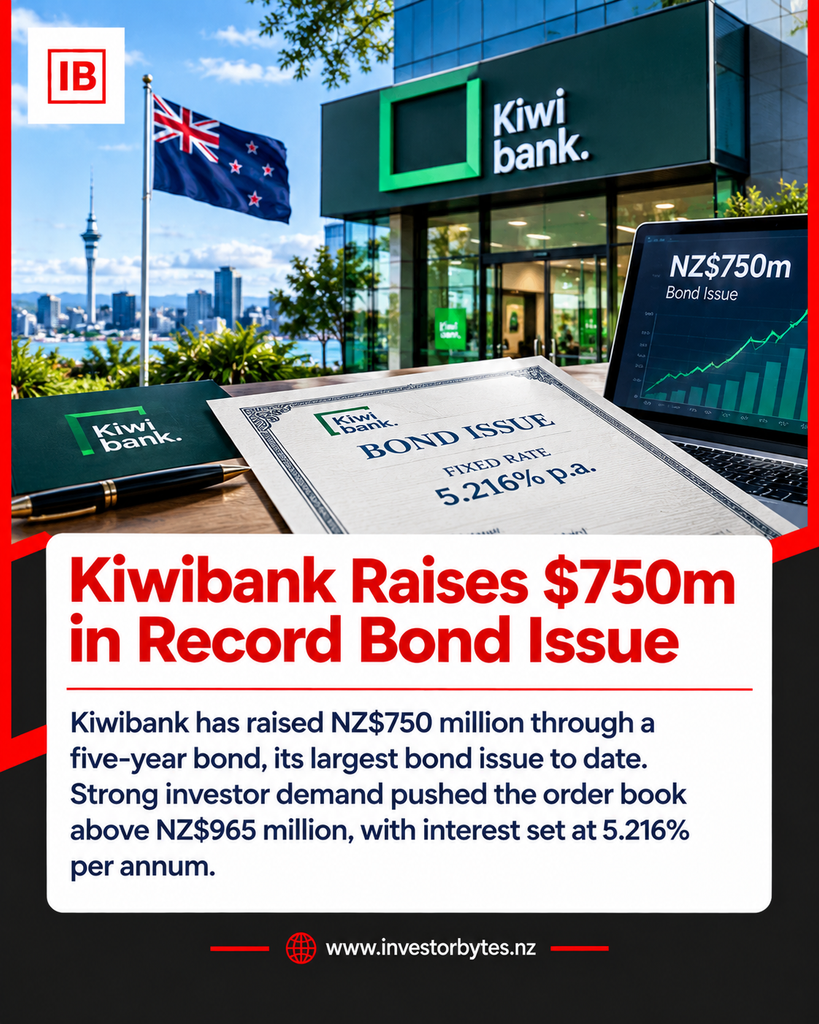
The latest Kiwibank bond issue raised NZ$750 million through a five-year bond, attracting more than NZ$965 million in investor orders.
Kiwibank Bond Issue Raises $750 Million as Investor Demand Remains Strong
Kiwibank has completed its largest bond issue to date, raising NZ$750 million through a five-year fixed-rate bond. The Kiwibank bond issue attracted a final order book of more than NZ$965 million, indicating strong demand from investors for the debt offering.
The issue is an important development for New Zealand’s fixed-income market and provides an insight into investor demand for bank-issued debt at a time when global and domestic interest rates remain closely watched.
Details of the Kiwibank Bond Issue
The Kiwibank bond issue consists of unsecured, unsubordinated fixed-rate medium-term notes.
The total issue size was NZ$750 million. Kiwibank initially indicated that it was seeking up to NZ$100 million, with the ability to accept additional subscriptions. Final investor orders exceeded NZ$965 million.
The interest rate was set at 5.216% per annum.
According to the published details, the rate represented a 0.75 percentage-point margin over the relevant reference swap rate.
The bond is scheduled to be issued on 30 September 2026 and mature on 30 September 2031.
What Strong Demand Indicates
Demand for a bond issue provides information about investor appetite for fixed-income securities.
When investors submit orders above the amount an issuer plans to raise, the issuer has greater flexibility in determining the final size and pricing of the transaction.
The strong order book for the Kiwibank bond issue therefore shows that institutional investors were willing to allocate significant capital to Kiwibank’s five-year debt.
However, strong demand should not automatically be interpreted as a prediction about future market performance. Bond investors consider factors including interest rates, credit quality, maturity, liquidity and portfolio requirements.
Why Banks Issue Bonds
Banks raise funding from a range of sources.
Customer deposits are an important source of funding, but banks also use wholesale markets, including debt securities, to diversify their funding base.
A Kiwibank bond issue allows the bank to access investors directly through the debt capital market.
For the investor, the bond provides scheduled interest payments subject to the terms of the security and repayment of principal at maturity, assuming the issuer meets its obligations.
For Kiwibank, the transaction provides longer-term funding that can support its broader banking operations.
What the 5.216% Rate Means
The 5.216% annual interest rate is an important part of the Kiwibank bond issue.
For investors holding the bond according to its terms, the coupon provides the stated annual interest payment. However, the effective return for investors who later buy or sell the bond can differ from the original coupon because bond prices move in response to market interest rates and other factors.
If market yields rise after issuance, existing fixed-rate bonds can become less attractive relative to newly issued securities, potentially putting downward pressure on their market prices.
If market yields fall, existing bonds with higher coupons can become relatively more attractive.
The Wider NZ Bond Market
The Kiwibank transaction comes as global bond yields have moved higher.
New Zealand government bond yields have also increased during September, influenced by global interest-rate developments, energy prices and inflation expectations.
The latest Kiwibank bond issue therefore provides useful context for investors following New Zealand fixed-income markets.
Bank bond pricing is influenced by the risk-free government yield curve as well as the additional credit spread investors require for lending to a bank.
What Investors Should Watch
Investors considering bank debt typically assess several factors.
These include the issuer’s financial position, capital levels, funding structure, liquidity, maturity and the legal terms of the security.
Investors also need to consider interest-rate risk. A five-year fixed-rate bond locks in its coupon, but the market value can change before maturity.
The Kiwibank bond issue demonstrates how banks can use the debt market to raise substantial amounts of capital while giving investors access to fixed-income assets.
Outlook
The NZ$750 million transaction is notable because it is Kiwibank’s largest bond issue to date.
With more than NZ$965 million of final orders, the Kiwibank bond issue attracted substantially more demand than the final amount issued.
The transaction highlights the continuing importance of wholesale funding for New Zealand banks and provides another data point for understanding investor demand in the domestic bond market.
For New Zealand financial-market observers, the issue will be relevant not only because of its size but also because of the pricing achieved in a market where global yields and central-bank expectations remain important drivers.
External Link
Interest.co.nz — Kiwibank $750m bond issue details
https://nz.investorbytes.com/wp-admin/post.php?post=26062&action=edit