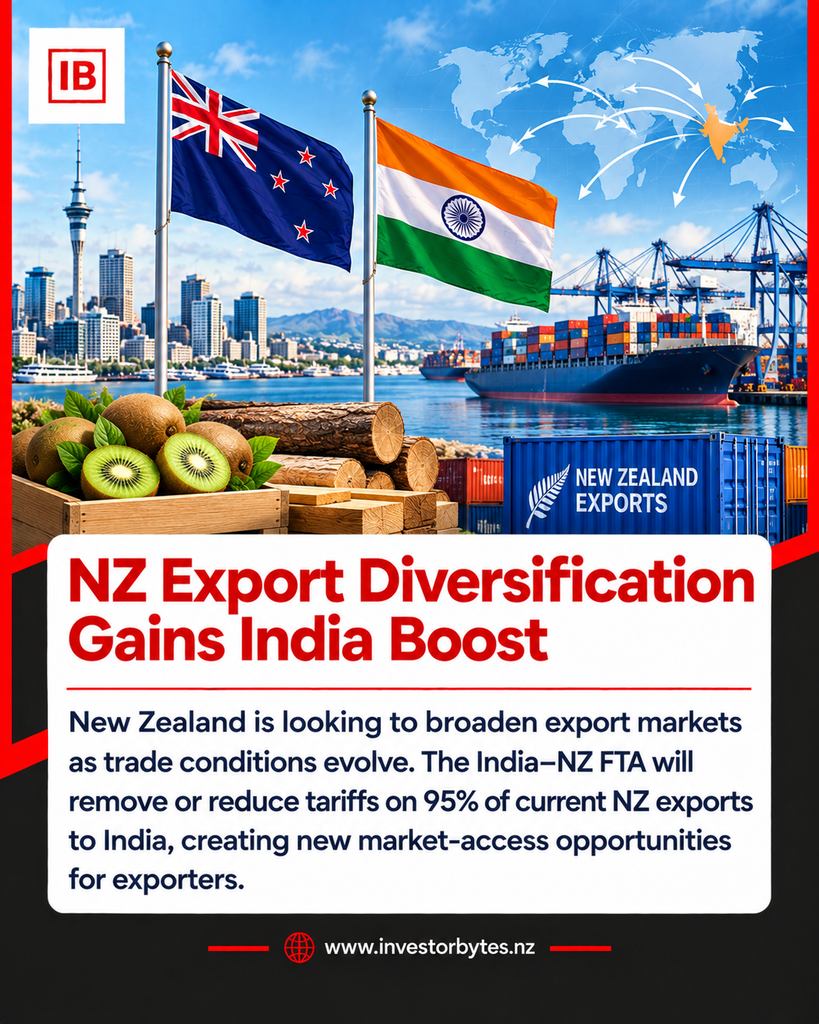
NZ export diversification is gaining momentum as the India–NZ FTA expands tariff preferences and market-access opportunities for New Zealand exporters.
NZ Export Diversification Gains Momentum Through India Trade Deal
New Zealand’s export strategy is receiving a significant boost from its new trade relationship with India, with the India–New Zealand Free Trade Agreement scheduled to enter into force on 20 October 2026.
The agreement is particularly relevant to NZ export diversification, providing New Zealand businesses with expanded access to one of the world’s largest markets.
According to the Ministry of Foreign Affairs and Trade, the agreement will provide preferential access for 95% of New Zealand’s current exports to India over time.
Why NZ Export Diversification Matters
New Zealand has historically relied heavily on a relatively concentrated group of export markets.
China remains a major trading partner, while Australia, the United States, Japan and other economies are also important destinations.
Recent NZIER analysis argues that the economic conditions behind New Zealand’s China trade boom are changing. The organisation says future NZ export diversification should focus on adding commercially attractive markets rather than simply reducing the importance of existing relationships.
India is one of the markets that could contribute to this strategy.
India Provides New Market Access
The India–NZ FTA offers substantial tariff preferences.
MFAT says 57% of New Zealand’s current exports to India will receive full tariff elimination immediately when the agreement enters into force. This rises to 82% over time, with another 13% receiving significant tariff reductions.
These provisions create a framework for stronger NZ export diversification.
However, tariff reductions alone do not guarantee export growth.
Businesses still need to establish distribution networks, understand customer demand and meet regulatory requirements.
Forestry and Horticulture Opportunities
Forestry is one area where the agreement provides immediate benefits.
More than 95% of New Zealand forestry exports to India will be able to enter tariff-free immediately, with tariffs on almost all current trade phased out over seven years.
Horticulture is another important area.
New quota access is being provided for kiwifruit and apples, while other horticultural products will receive phased tariff reductions.
These measures could help support NZ export diversification by giving agricultural exporters additional commercial opportunities.
Food and Beverage Exports
New Zealand has strong international recognition in food and beverage products.
The agreement includes tariff benefits for products including wine and mānuka honey.
MFAT says tariffs on New Zealand wine will be reduced by 66% to 83% over ten years, while tariffs on mānuka honey will be cut by 75% over five years.
For exporters, these changes could improve price competitiveness over time.
Services Are Also Important
NZ export diversification is not limited to physical products.
New Zealand has a substantial services economy covering education, professional services, tourism, engineering and other sectors.
The India agreement contains services commitments across a range of areas, including engineering, environmental services, tertiary and adult education, financial services and telecommunications.
This provides opportunities for companies that may not traditionally think of themselves as exporters.
Digital businesses and professional service firms can potentially use international agreements to expand their customer base without shipping physical products.
Investment Opportunities
Trade and investment are increasingly connected.
The India–NZ FTA includes investment cooperation provisions designed to deepen the commercial relationship.
The agreement also includes an Indian commitment to establish a New Zealand Investment Desk to assist New Zealand investors with issues arising during the investment lifecycle.
For New Zealand businesses, this could support the development of deeper commercial relationships with Indian partners.
Challenges for Exporters
Despite the opportunities, NZ export diversification will require businesses to understand the practical realities of the Indian market.
India is highly competitive and has different regulatory, distribution and consumer environments across sectors and regions.
Businesses will need to consider logistics, certification, pricing, local partnerships and product adaptation.
Exporters also need to understand the specific tariff schedules and rules of origin that apply to their products.
Long-Term Outlook
The India agreement is an example of how New Zealand can expand its international trade network.
Rather than relying on a single large market to drive future growth, NZ export diversification can involve developing several complementary markets.
India is potentially important because of its scale and long-term economic growth prospects.
At the same time, the benefits will depend on business execution.
Companies that successfully understand the market, develop local relationships and use the agreement’s tariff and services provisions could be positioned to expand their international presence.
The NZ export diversification story will therefore be measured not simply by the signing of trade agreements but by actual growth in exports, investment and commercial activity.
External Links
NZIER — China trade relationship and diversification
https://nz.investorbytes.com/wp-admin/post.php?post=26062&action=edit