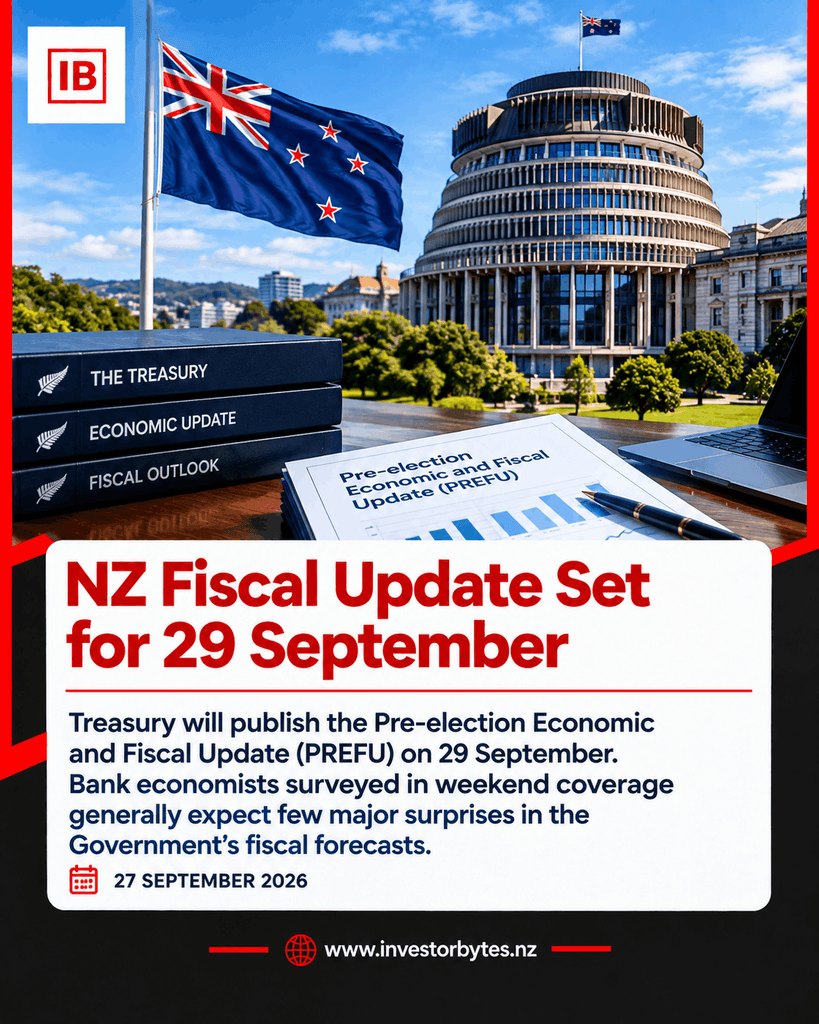
NZ Fiscal Update is due on 29 September, with bank economists watching Treasury forecasts, government finances, economic growth and fiscal risks.
Suggested Table of Contents
- NZ Fiscal Update: What Is Being Released?
- Why the NZ Fiscal Update Matters
- What Economists Are Watching
- Government Finances and Fiscal Forecasts
- Economic Growth and Inflation
- Oil Prices and Fiscal Risks
- What It Could Mean for Markets
- Outlook for New Zealand
- Frequently Asked Questions
- Conclusion
NZ Fiscal Update: What Is Being Released?
New Zealand’s NZ Fiscal Update is scheduled for 29 September 2026, when Treasury is due to publish the Pre-election Economic and Fiscal Update, commonly known as PREFU. The update will provide an assessment of the country’s economic and fiscal position ahead of the general election.
The latest weekend coverage from interest.co.nz reported that economists at several major banks were not expecting dramatic surprises in the Government’s fiscal forecasts. However, economists highlighted several areas where the updated numbers could differ from forecasts published in Budget 2026.
The NZ Fiscal Update is particularly important because it refreshes Treasury’s economic and fiscal projections. It also provides information about potential risks that could affect government finances and the broader economy.
Why the NZ Fiscal Update Matters
The NZ Fiscal Update gives markets, businesses and the public a new snapshot of government finances.
Treasury’s projections cover areas such as government revenue, expenditure, economic growth and the expected fiscal balance. These figures can influence expectations around government borrowing, spending and future fiscal policy.
For financial markets, the update can also provide information about how Treasury views the economic environment.
Economists quoted in the latest coverage generally expected the update to remain broadly consistent with previous forecasts, although they identified risks around economic growth, interest rates and commodity prices.
What Economists Are Watching
One key issue is the path of the government’s operating balance.
BNZ economist Doug Steel highlighted the performance of the OBEGALx measure, while ASB economist Mark Smith said the fiscal position remained less well placed to absorb adverse shocks than before the Global Financial Crisis. ANZ’s Miles Workman also noted that monetary policy had tightened more aggressively than assumed in the Budget forecast.
These differences make the NZ Fiscal Update relevant to investors monitoring government borrowing and economic policy.
Another issue is the medium-term economic outlook.
If Treasury’s forecasts are revised, expectations for government revenue and expenditure could also change. That could influence how investors assess New Zealand’s fiscal position.
Government Finances and Fiscal Forecasts
The NZ Fiscal Update will update forecasts made in Budget 2026.
Government revenue is closely connected to economic activity. Stronger employment, business profits, household spending and corporate activity can support tax revenue, while weaker growth can place pressure on government finances.
The latest economist commentary suggests there are several moving parts.
Some recent fiscal outcomes have been better than previous forecasts, while economists have also highlighted longer-term pressures such as population ageing and infrastructure requirements.
This means the NZ Fiscal Update will be watched not only for the immediate fiscal balance but also for longer-term projections.
Economic Growth and Inflation
Economic growth will be another important component.
The NZ economy has been moving through a period where interest rates, inflation, population growth and international commodity prices all affect economic activity.
Higher interest rates can slow household and business demand, while stronger export prices can provide support for national income.
The NZ Fiscal Update will therefore give investors another reference point for assessing the balance between economic recovery and fiscal pressure.
Oil Prices and Fiscal Risks
Oil prices have also become a relevant issue for the 2026 forecasts.
Recent market reports have shown Brent crude trading significantly above levels assumed in earlier Treasury forecasts. ANZ economist Miles Workman specifically highlighted the difference between recent oil prices and the assumptions used in Budget 2026.
Higher energy prices can influence inflation, transport costs and household purchasing power.
That makes energy prices another factor investors may examine when reading the NZ Fiscal Update.
What It Could Mean for Markets
The NZ Fiscal Update could be relevant to several areas of the financial market.
Government bond investors may examine borrowing requirements and fiscal projections. Currency traders may assess the implications for economic growth and monetary policy expectations. Equity investors may focus on the potential effects of government spending and economic activity.
However, the fiscal update itself will not determine market movements. Markets will also respond to international interest rates, commodity prices, exchange rates and global economic developments.
Outlook for New Zealand
The 29 September NZ Fiscal Update will provide a refreshed assessment of New Zealand’s economic and fiscal outlook.
Economists surveyed in the latest weekend coverage generally expected no major surprises, although several identified downside risks and uncertainty around medium-term forecasts.
For investors, the important information will be the updated numbers, assumptions and risk assessment contained in the Treasury document.
Frequently Asked Questions
When is the NZ Fiscal Update?
The 2026 Pre-election Economic and Fiscal Update is scheduled for 29 September 2026.
What is PREFU?
PREFU is the Pre-election Economic and Fiscal Update, which provides updated economic and fiscal forecasts before a general election.
Why is the NZ Fiscal Update important?
It provides updated information about government finances, economic forecasts and fiscal risks.
Will the NZ Fiscal Update affect markets?
It may influence market expectations, although financial markets also respond to international economic and financial developments.
Conclusion
The NZ Fiscal Update will provide investors and businesses with an important new snapshot of New Zealand’s economic and fiscal position. While economists have generally expected limited surprises, changes to economic assumptions, fiscal forecasts and risk assessments will be closely watched.
Internal links to add:
- Link “New Zealand GDP Growth” → your NZ GDP article
- Link “RBNZ OCR” → your RBNZ interest-rate article
- Link “NZ Dollar” → your NZD article
External DoFollow link:
Treasury New Zealand
Source: Interest.co.nz PREFU coverage
https://nz.investorbytes.com/wp-admin/post.php?post=26087&action=edit