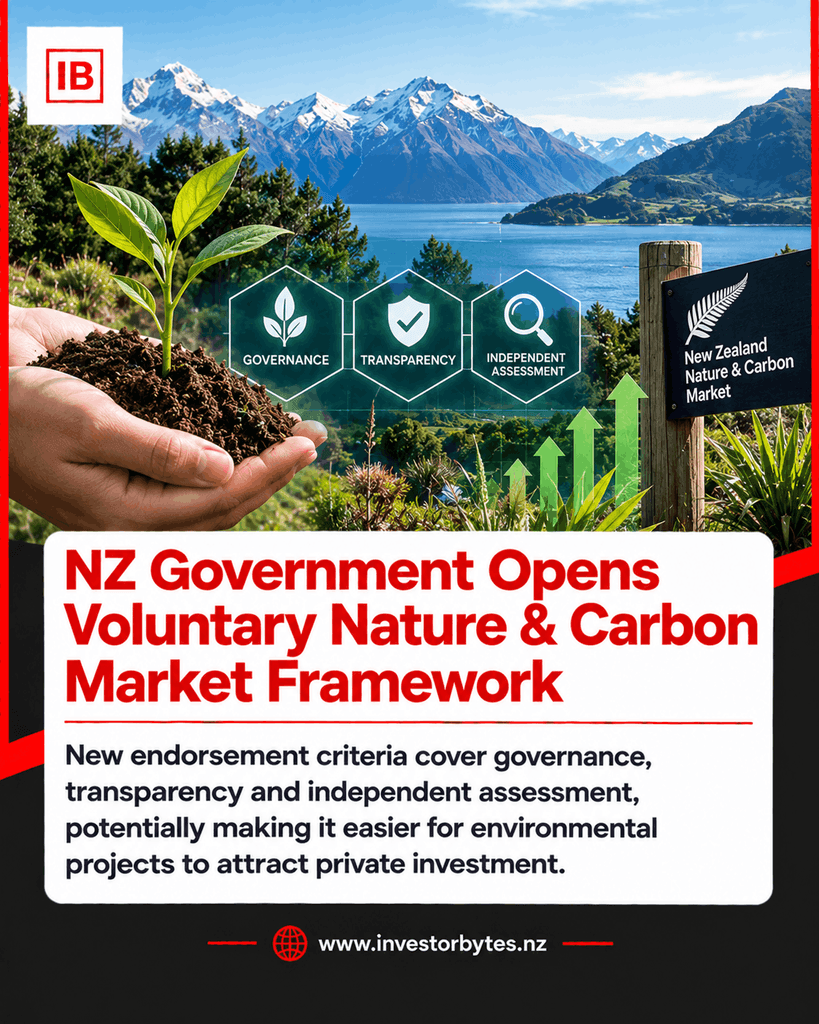
The NZ Nature and Carbon Market framework introduces endorsement criteria for governance, transparency and independent assessment, supporting investor confidence.
NZ Nature and Carbon Market Framework Opens New Investment Pathways
New Zealand has released new endorsement criteria for its voluntary nature and carbon markets, creating a framework designed to improve confidence in environmental projects and encourage private investment. The NZ Nature and Carbon Market framework focuses on governance, transparency, independent assessment and evidence that environmental outcomes are real and measurable.
The framework is designed for privately run markets where investors can provide funding for projects such as native planting, wetland restoration, habitat protection and carbon removal. These projects can potentially create new income opportunities for landowners, farmers, iwi, community organisations and project developers.
What Is the NZ Nature and Carbon Market?
The NZ Nature and Carbon Market is part of New Zealand’s developing voluntary environmental market system. Unlike compulsory emissions markets, voluntary markets allow organisations and individuals to support environmental projects through privately purchased credits.
Under the framework, projects can generate credits when environmental outcomes are measured against recognised standards. Buyers can then purchase those credits to support documented environmental outcomes.
The Government says its role is to provide a quality signal rather than guarantee individual transactions. This distinction is important because buyers will still need to conduct their own due diligence before committing capital.
New Endorsement Criteria
The new NZ Nature and Carbon Market criteria introduce a domestic endorsement pathway for schemes seeking a New Zealand quality signal.
Schemes can be assessed independently against New Zealand’s integrity principles. The Government’s framework identifies principles including additionality, durability, measurable outcomes, transparency, respect for rights and avoiding double-counting.
Independent assessment is particularly relevant for investors because environmental markets depend heavily on confidence in the underlying projects and credits.
Potential Impact on Private Investment
The NZ Nature and Carbon Market framework could make it easier for investors to identify schemes that meet recognised integrity standards.
New Zealand’s Ministry for the Environment says the framework is intended to help attract private investment into nature and climate projects. The Government has also indicated that public conservation land may become available for privately funded projects that deliver additional environmental benefits.
For investors, this could expand the range of environmental projects available for consideration. For landowners and project developers, a recognised endorsement pathway could provide another way to demonstrate the credibility of a project.
Why Governance and Transparency Matter
Governance is an important part of the NZ Nature and Carbon Market because investors need information about how schemes operate, how environmental outcomes are measured and how credits are issued.
Transparency can also help reduce uncertainty around environmental claims. Independent assessment adds another layer of scrutiny, potentially giving market participants more information when evaluating projects.
However, endorsement is not a guarantee of investment performance. The Government specifically describes endorsement as a quality signal rather than a Crown guarantee.
Outlook for New Zealand
The development of the NZ Nature and Carbon Market reflects growing interest in private finance for environmental projects. The Government’s approach has been informed by pilot projects involving different land conditions, project types and market participants.
For New Zealand businesses and investors, the framework creates another developing area to monitor alongside traditional environmental and carbon markets.
The NZ Nature and Carbon Market may become increasingly relevant to agriculture, forestry, conservation, climate finance and sustainable investment. Its development will depend on participation, market demand, the quality of projects and confidence in the assessment process.
Conclusion
The NZ Nature and Carbon Market framework introduces a more structured approach to voluntary environmental markets in New Zealand. By focusing on governance, transparency and independent assessment, the framework aims to give investors and project developers clearer signals about market integrity.
For investors, farmers, landowners and environmental businesses, the NZ Nature and Carbon Market is an emerging part of New Zealand’s sustainable finance landscape worth monitoring as the endorsement system develops.
External resource: New Zealand Ministry for the Environment – Voluntary Nature and Carbon Markets