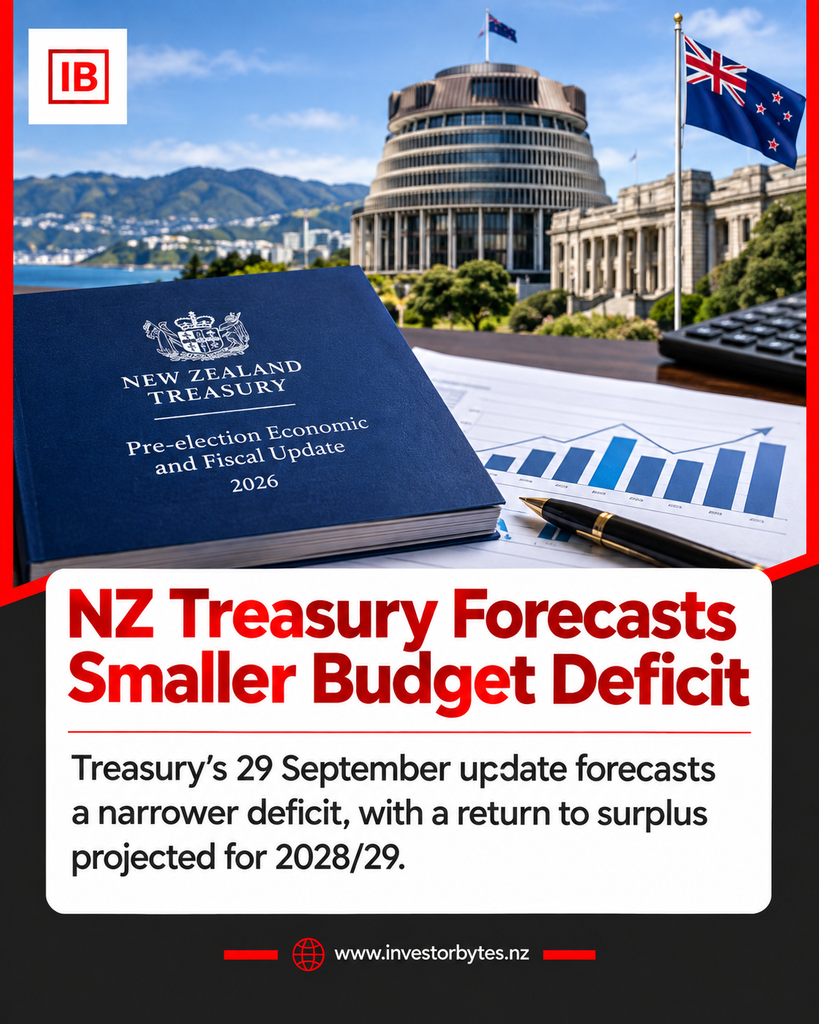
NZ Treasury forecasts a smaller budget deficit, stronger growth and improving fiscal conditions. Here are 7 critical facts from the 29 September 2026 update.
Table of Contents
- NZ Treasury Forecasts Smaller Budget Deficit
- Why the Fiscal Outlook Has Improved
- Economic Growth and Revenue
- Government Spending and Fiscal Pressure
- Debt and Borrowing Outlook
- Risks to the Forecast
- What the Update Means for New Zealand
- Conclusion
NZ Treasury Forecasts Smaller Budget Deficit
The NZ Treasury forecasts smaller budget deficit conditions as New Zealand’s fiscal outlook improves in the latest Pre-election Economic and Fiscal Update released on 29 September 2026. Treasury’s update shows that stronger economic activity and higher expected tax revenue are contributing to a better fiscal position than previously forecast.
The update is significant because New Zealand has spent recent years dealing with weak economic activity, elevated inflation pressures and substantial fiscal deficits. The latest figures indicate that the government’s operating balance is expected to improve over the forecast period, although fiscal risks remain.
According to Treasury, the deficit for the year ending June 2027 is forecast at NZ$6.8 billion, compared with the NZ$11.4 billion forecast in the 2026 Budget Update. The operating balance before gains and losses excluding ACC, known as OBEGALx, is then expected to move closer to balance in 2027/28 before reaching a projected surplus in 2028/29.
Why the Fiscal Outlook Has Improved
One of the main reasons behind the improvement is stronger expected government revenue.
Treasury has revised core Crown tax revenue higher by NZ$11.4 billion over four comparable years of the forecast period. Higher revenue is partly offset by policy decisions affecting fuel excise duties and road-user charges, but the overall revenue outlook has strengthened.
This matters because government revenue is closely connected with economic activity. When businesses generate more income, employment increases and household earnings improve, tax collections can also rise.
The government has said the deficit for the year ending July was NZ$3.4 billion smaller than forecast in the May Budget, reflecting stronger economic momentum.
Economic Growth and Revenue
The latest Treasury forecast expects the New Zealand economy to regain momentum during the second half of 2026.
Real production GDP is forecast to grow by 1.6% in the year to June 2026, followed by 2.3% in 2027 and 2.9% in 2028. Growth then remains around 2.5% to 2.7% in subsequent years.
The recovery is expected to receive support from exports, improving terms of trade, household income and business activity.
However, the recovery is not without challenges. Treasury says higher oil prices and inflation pressures could affect economic growth and interest rates. Persistent energy costs could weaken household purchasing power and increase business costs.
Government Spending and Fiscal Pressure
A smaller deficit does not mean that fiscal pressures have disappeared.
Government expenditure remains significant, particularly in areas such as health, social security and welfare. Treasury’s figures show that expenditure pressures will continue to influence future Budgets.
The fiscal improvement is therefore partly dependent on increasing revenue and controlling the growth of expenditure.
Treasury projects the OBEGALx deficit to fall from NZ$8.6 billion in 2025/26 to NZ$6.8 billion in 2026/27 and NZ$0.8 billion in 2027/28. It then forecasts a NZ$4 billion surplus in 2028/29.
Debt and Borrowing Outlook
The improved fiscal position is also affecting New Zealand’s borrowing programme.
Treasury’s debt-management office announced on 29 September that the forecast New Zealand Government Bond programme has been reduced by NZ$15 billion across the forecast period compared with the Budget Economic and Fiscal Update.
The 2026/27 bond programme has been reduced to NZ$30 billion, while later annual borrowing programmes have also been revised lower.
This is an important development for financial markets because government borrowing requirements can influence bond markets and interest costs.
Risks to the Forecast
Despite the improved outlook, Treasury has highlighted several risks.
Oil prices remain a major uncertainty. If energy prices stay elevated for longer than expected, inflation could become more persistent. That could place pressure on interest rates and reduce economic activity.
Other medium-term risks include productivity growth, migration and New Zealand’s terms of trade.
These risks mean that the NZ Treasury forecasts smaller budget deficit outlook should be viewed as a forecast rather than a guaranteed result.
What the Update Means for New Zealand
The latest figures provide an important snapshot of New Zealand’s economic and fiscal direction.
For businesses, stronger economic activity could support demand, investment and employment. For financial markets, lower borrowing requirements and improving fiscal projections may influence expectations around government bonds and interest costs.
For households, the outlook is connected with employment, wages, inflation and interest rates.
The key point is that New Zealand’s fiscal position is projected to improve, but the improvement depends on economic conditions remaining sufficiently supportive and fiscal risks remaining manageable.
Conclusion
The NZ Treasury forecasts smaller budget deficit outlook is one of the major economic developments reported on 29 September 2026. Treasury expects smaller deficits in the near term, improving operating balances and a return to surplus in 2028/29.
However, oil prices, inflation, interest rates and global economic conditions remain important risks.
For investors and businesses following New Zealand, the Treasury update provides a useful framework for understanding the country’s fiscal outlook over the coming years.
Suggested internal links: New Zealand GDP growth, NZX 50 market update, New Zealand jobs outlook
External source: New Zealand Treasury – Pre-election Economic and Fiscal Update 2026
https://nz.investorbytes.com/wp-admin/post.php?post=26117&action=edit