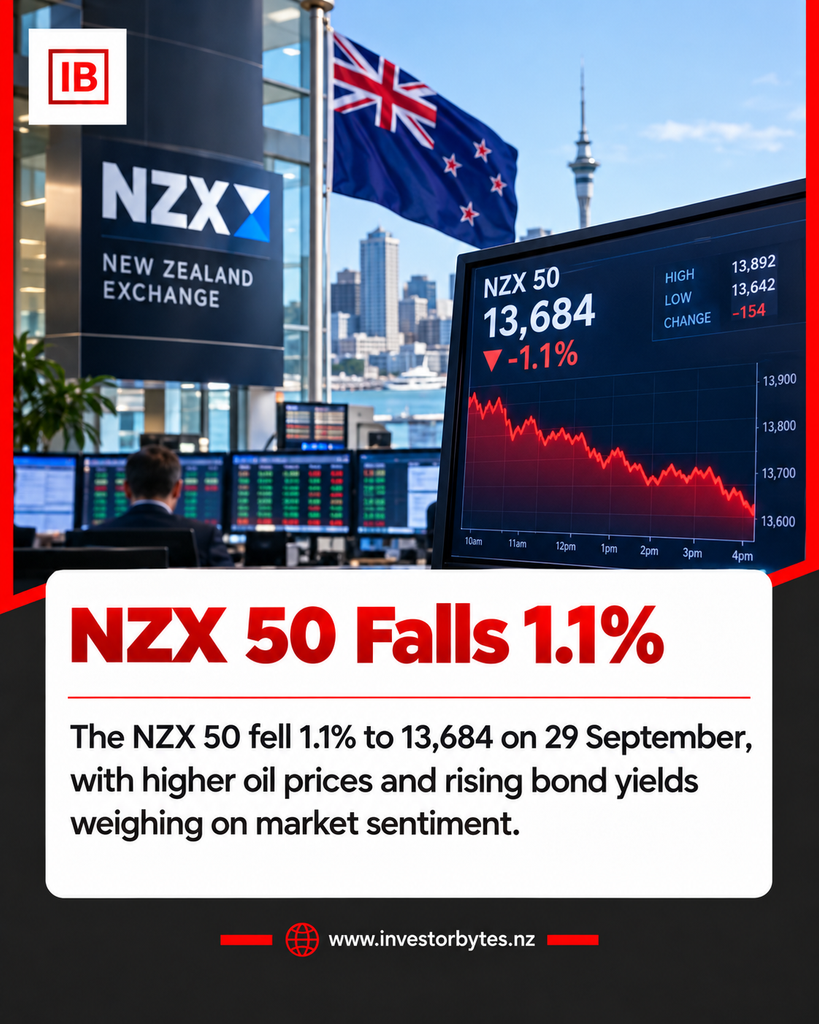
NZX 50 falls 1.1% amid higher oil prices and rising bond yields. Explore 7 key market factors behind the 29 September 2026 decline.
Table of Contents
- NZX 50 Falls 1.1%
- Market Performance
- Oil Prices and Inflation
- Bond Yields
- Sector Performance
- Hallenstein Glasson
- Global Market Influence
- What Investors Should Watch
- Conclusion
NZX 50 Falls 1.1%
The NZX 50 falls 1.1% story was one of New Zealand’s major market developments on 29 September 2026. A market report said the index declined by 147 points, or 1.1%, to 13,684 as higher oil prices and rising Treasury yields weighed on sentiment.
There is an important data point for readers: a later NZX market observation reported the S&P/NZX 50 at 13,724.87, down 0.77%. This difference appears to reflect different market-data observations or reporting times, so investors should use the official NZX data for final closing figures.
Market Performance
The market decline came amid a broader risk-sensitive environment.
Higher global bond yields and renewed inflation concerns were among the factors affecting investor sentiment.
New Zealand’s share market is influenced not only by domestic economic data but also by developments in the United States, China, commodity markets and global interest rates.
Oil Prices and Inflation
Oil prices were an important part of the market story.
Higher energy prices can increase costs for consumers and businesses. They can also contribute to inflation.
For investors, persistent inflation can be important because central banks may maintain higher interest rates for longer when price pressures remain elevated.
That can affect valuations across equity markets.
Bond Yields
Rising bond yields were another major factor.
Government bond yields influence the cost of capital across financial markets. When yields rise, investors may reassess the relative attractiveness and valuation of equities.
The market report said US Treasury yields increased amid higher oil prices, inflation concerns and expectations around US monetary policy.
Sector Performance
The decline was broad.
According to the market report, energy stocks were among the weakest performers. Channel Infrastructure fell 3.6%, Summerset Group declined 3.2%, Meridian Energy dropped 2.9% and Freightways fell 2.2%.
The official NZX-related data reported by Newswire also showed weakness in several sectors, including energy, consumer staples, communications and utilities.
Hallenstein Glasson
Not every company moved lower.
Hallenstein Glasson gained strongly after reporting a significant increase in annual profit.
The company reported net profit after tax of NZ$59.2 million, up 49.9%, while group sales increased 19.6%.
The result demonstrates that company-specific earnings can sometimes outweigh broader market weakness.
Global Market Influence
The NZX 50 falls 1.1% story also illustrates the influence of international markets.
New Zealand is a relatively small open economy. Investors therefore monitor US bond yields, commodity prices, Chinese economic activity and global monetary policy.
Changes in global risk sentiment can influence New Zealand shares even when there is limited domestic news.
What Investors Should Watch
Investors will continue watching oil prices, inflation data, central-bank expectations and company earnings.
New Zealand economic indicators can also influence expectations around interest rates and corporate demand.
The NZX’s performance should therefore be assessed alongside the wider economic environment rather than through a single trading session.
Conclusion
The NZX 50 falls 1.1% report highlights the sensitivity of New Zealand equities to global oil prices, bond yields and inflation concerns.
Because market-data observations can differ by reporting time, investors should check official NZX data when using the figure for financial decisions.
External source: NZX Main Board market data
https://nz.investorbytes.com/wp-admin/post.php?post=26114&action=edit