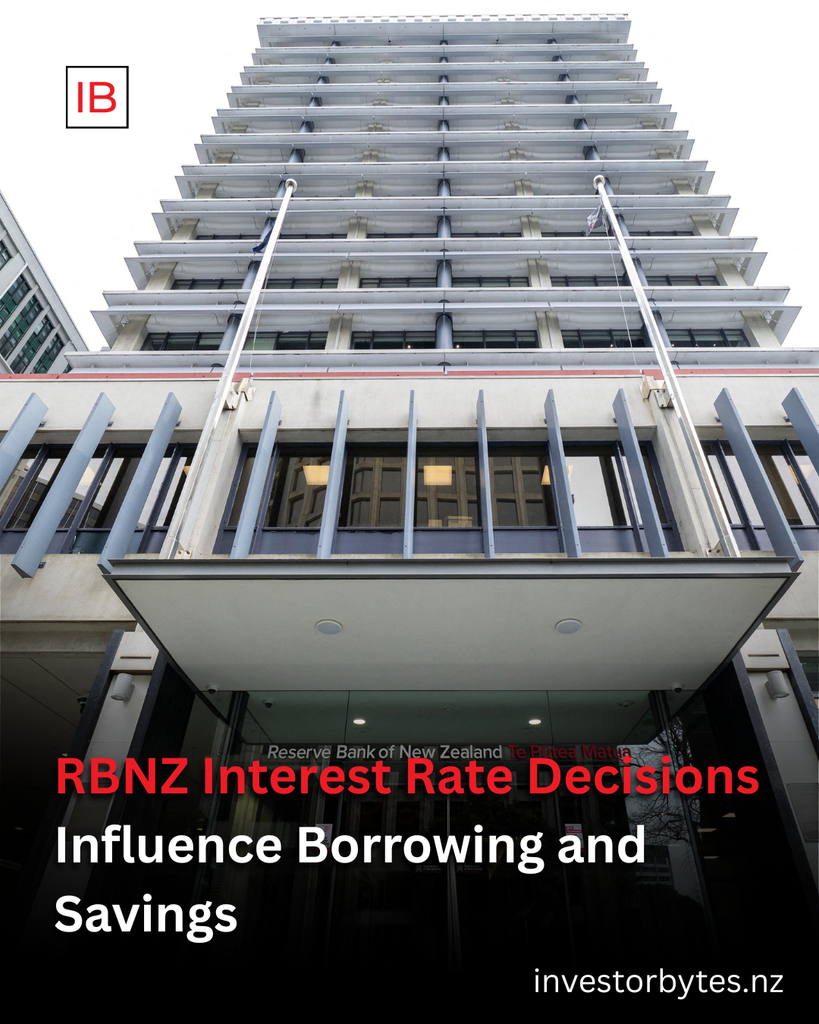
Discover how RBNZ interest rate decisions affect New Zealand mortgages, savings accounts, business borrowing, inflation and household budgets in 2026.
RBNZ Interest Rate Decisions: 7 Key Ways Borrowing and Savings Are Affected
New Zealand’s monetary policy decisions play an important role in household finances, business investment and the wider economy. The RBNZ interest rate decisions influence the cost of borrowing, the returns available on savings and the financial choices made by households and businesses across the country.
On 2 September 2026, the Reserve Bank of New Zealand (RBNZ) increased the Official Cash Rate (OCR) by 25 basis points to 2.75%. The central bank explained that higher fuel prices had contributed to inflation reaching 4.1% in the June 2026 quarter. The next scheduled OCR announcement is 28 October 2026.
For homeowners, first-home buyers, savers, investors and business owners, understanding how the OCR works can help with budgeting and financial planning. This guide explains the current position and seven important ways interest rate decisions can affect New Zealand’s economy.
Table of Contents
- What Are RBNZ Interest Rate Decisions?
- Current Official Cash Rate in New Zealand
- Seven Ways Interest Rates Affect New Zealanders
- How Interest Rate Changes Influence Inflation
- What Borrowers and Savers Should Consider
- What Could Happen Next?
- Frequently Asked Questions
- Conclusion
1. What Are RBNZ Interest Rate Decisions?
The Reserve Bank of New Zealand is responsible for monetary policy aimed at maintaining price stability. One of its main tools is the Official Cash Rate, commonly known as the OCR.
The OCR influences the interest rates banks charge borrowers and offer to depositors. When the Reserve Bank changes the rate, financial institutions may adjust mortgage rates, personal loan rates, business lending rates and savings account returns.
The relationship is not automatic or identical across every bank. Banks also consider wholesale funding costs, competition, risk, loan terms and broader financial market conditions.
The RBNZ reviews monetary policy regularly, examining inflation, employment, economic growth, consumer demand and international developments. Its decisions aim to keep inflation within its target range over time while supporting sustainable economic activity.
Official source: https://www.rbnz.govt.nz/monetary-policy/about-monetary-policy/the-official-cash-rate
2. Current Official Cash Rate in New Zealand
As of 15 October 2026, the published OCR is 2.75%, following the Reserve Bank’s 25-basis-point increase on 2 September 2026.
The central bank said higher petrol and diesel prices had contributed to inflationary pressure. Annual consumer price inflation reached 4.1% in the June quarter, above the RBNZ’s 1%–3% target range.
The Bank also noted that New Zealand’s economic recovery was continuing, supported in part by export demand. However, household spending remained weak and unemployment had increased, creating a challenging balance between controlling inflation and supporting economic activity.
The next scheduled monetary policy review is on 28 October 2026. That meeting will provide updated information about the OCR and the Reserve Bank’s assessment of economic conditions.
It is important to distinguish a confirmed decision from a forecast. Market expectations and economists’ predictions may change before an announcement, and the actual decision remains uncertain until the Reserve Bank publishes it.
3. Seven Ways Interest Rates Affect New Zealanders
1. Mortgage repayments and home loans
Mortgage rates are one of the most visible ways RBNZ interest rate decisions affect households. When banks raise lending rates, borrowers refinancing or taking out new loans may face higher costs. Existing borrowers on fixed rates generally experience the change when their fixed term expires, while floating-rate borrowers may be affected sooner.
For example, a change in the interest rate can significantly alter the total interest paid on a large mortgage. The exact impact depends on the outstanding balance, loan term, repayment structure and rate offered by the lender.
Homeowners approaching a refix date can review their budget and compare available loan options rather than assuming every lender will offer the same rate.
2. Savings accounts and term deposits
Higher interest rates can create opportunities for savers because banks may increase returns on savings accounts and term deposits.
However, savings rates do not necessarily move in line with the OCR. The timing and size of any change depend on the bank, the product and market competition.
Savers should compare the advertised rate, fees, access restrictions and term conditions. They should also consider inflation: the purchasing power of savings depends on the return after accounting for rising prices and any applicable tax.
3. Personal loans and credit cards
Interest rate movements can influence personal loans and other borrowing products. Some lending rates respond more quickly than others, and credit card rates may not follow the OCR closely.
People carrying high-interest debt should understand their repayment obligations and the total cost of borrowing. Making only minimum payments can extend repayment periods and increase the amount of interest paid.
Before taking out new debt, borrowers can compare the annual percentage rate, fees, repayment schedule and early repayment conditions.
4. Business borrowing and investment
Businesses use borrowing to finance equipment, inventory, property, expansion and day-to-day operations. Higher lending costs can make some projects less attractive or require businesses to adjust their investment plans.
Small and medium-sized enterprises may be particularly sensitive to changes in overdraft rates and working-capital costs. Businesses considering new investment should evaluate expected revenue, cash flow, debt servicing and alternative funding options.
Lower rates can reduce financing costs, but investment decisions still depend on customer demand, competition, wages, energy prices and business confidence.
5. Inflation and everyday living costs
The OCR is one of the Reserve Bank’s tools for controlling inflation. Higher interest rates generally discourage some borrowing and spending, which can reduce demand and ease pressure on prices over time.
However, interest rate changes cannot directly reverse every price increase. Global oil prices, exchange rates, shipping costs, weather conditions and supply disruptions can also influence the prices New Zealand households pay.
Monetary policy also works with a delay. Even after the OCR changes, the effect on spending, wages and inflation may take time to become visible.
6. Housing demand and property activity
Interest rates influence mortgage affordability and the amount households can borrow. Higher mortgage rates may reduce the purchasing power of some buyers and affect housing demand. Lower rates may improve affordability for eligible borrowers, although house prices also depend on supply, population changes, incomes and lending standards.
Property owners should avoid assuming that a particular OCR decision guarantees a rise or fall in house prices. Local conditions and individual circumstances matter.
7. The New Zealand dollar and financial markets
Interest rate expectations can influence the New Zealand dollar, bond yields and share-market valuations. Currency movements also depend on overseas interest rates, global risk sentiment, commodity prices and expectations for economic growth.
A stronger or weaker New Zealand dollar can affect import costs, exporters’ revenue and the value of overseas investments when converted into New Zealand dollars.
Investors should therefore consider the wider economic environment rather than treating a single OCR announcement as a complete market forecast.
4. How Interest Rate Changes Influence Inflation
Inflation measures how quickly the general level of prices rises. When inflation remains above the Reserve Bank’s target range, policymakers may consider whether monetary conditions need to be tighter to prevent persistent price increases.
Higher interest rates can encourage saving, increase debt-servicing costs and reduce some forms of consumer and business spending. If demand cools, businesses may face less pressure to increase prices.
There are limits to this mechanism. When inflation is driven by international energy prices or supply disruptions, domestic interest rate policy cannot immediately increase global oil supply or remove shipping constraints.
The RBNZ must assess both the source of inflation and the risk that temporary price shocks become persistent. Its decisions are therefore based on a range of economic indicators, not just one inflation figure.
For households, this means inflation and borrowing costs can move in uncomfortable directions at the same time. Budget planning should account for both essential living expenses and potential changes in debt repayments.
5. What Borrowers and Savers Should Consider
The best response to changing interest rates depends on each person’s financial position. There is no single strategy that suits every household.
For mortgage holders:
- Check when your current fixed rate expires.
- Compare the total cost of available mortgage offers.
- Consider whether your budget could handle higher repayments.
- Ask your lender about fees and the conditions attached to refinancing.
For savers:
- Compare term deposit and savings account rates.
- Check early withdrawal rules and access to funds.
- Consider the effect of inflation and tax on returns.
- Maintain an appropriate emergency fund.
For business owners:
- Review cash-flow forecasts and debt repayments.
- Assess whether planned borrowing remains affordable.
- Consider changes in customer demand and operating expenses.
- Avoid relying on a particular future OCR outcome.
These are general financial planning considerations, not personalised financial advice.
6. What Could Happen Next?
The next scheduled RBNZ monetary policy announcement is 28 October 2026. Before that date, markets and economists will continue examining inflation data, employment conditions, household spending, economic growth and global developments.
The Reserve Bank’s decision is not predetermined. A future rate increase, decrease or hold would depend on the incoming evidence and the Bank’s assessment of inflation risks and economic conditions.
For households and investors, it is more useful to prepare for different possibilities than to rely on a single forecast. Reviewing debt obligations, maintaining financial flexibility and understanding the terms of savings and lending products can help people respond to changing conditions.
Follow official RBNZ announcements for confirmed decisions rather than relying exclusively on market speculation.
7. Frequently Asked Questions
What is the current RBNZ interest rate?
As of 15 October 2026, the published Official Cash Rate is 2.75%. The Reserve Bank’s next scheduled OCR announcement is 28 October 2026.
Do RBNZ interest rate decisions directly change every mortgage rate?
No. The OCR influences lending conditions, but banks set their own mortgage rates based on funding costs, competition, loan terms and other factors. Fixed-rate borrowers may not see a change until their fixed term ends.
Can higher interest rates benefit savers?
They can, if banks offer higher deposit rates. However, savings returns vary by provider and product, and inflation affects the purchasing power of money.
Why does the Reserve Bank raise interest rates?
The RBNZ may raise rates when it believes tighter monetary conditions are needed to bring inflation back towards its target range and prevent persistent price pressures.
When is the next OCR decision?
The next scheduled announcement is 28 October 2026. The official announcement will confirm the decision.
Conclusion
RBNZ interest rate decisions influence mortgages, savings, consumer spending, business investment and financial markets throughout New Zealand. The OCR stood at 2.75% on 15 October 2026 following the September increase, with another scheduled review approaching on 28 October.
Understanding how interest rates work can help households and businesses plan for uncertainty. Rather than assuming that rates or property prices will move in a particular direction, borrowers, savers and investors should review their circumstances, compare available products and follow official economic updates.
For more New Zealand business, finance, tax and investment coverage, follow InvestorBytes NZ.
https://nz.investorbytes.com/wp-admin/post.php?post=26184&action=edit