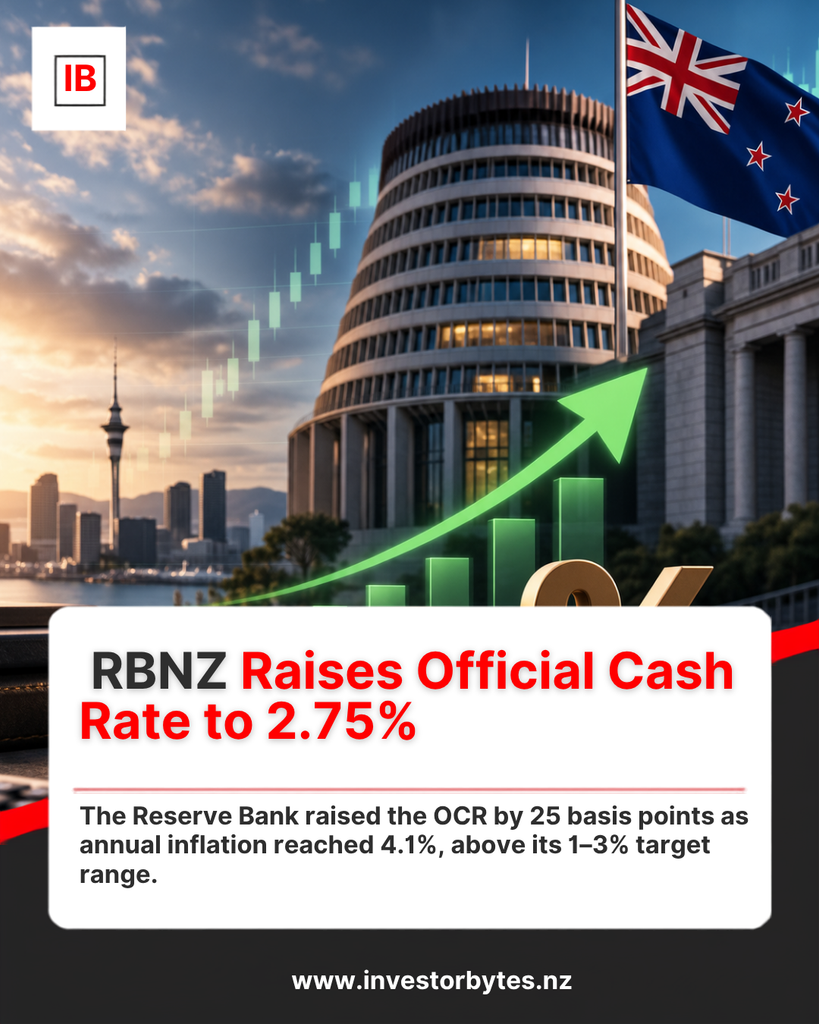
BNZ Official Cash Rate rises to 2.75% as New Zealand inflation reaches 4.1%, with the central bank focused on returning inflation to its 1–3% target.
RBNZ Official Cash Rate Rises to 2.75%
The Reserve Bank of New Zealand (RBNZ) increased its RBNZ Official Cash Rate by 25 basis points to 2.75%, marking another step toward bringing inflation back toward its medium-term target. The Monetary Policy Committee reached the decision by consensus on September 2, 2026.
The decision came after annual consumer price inflation increased to 4.1% in the June 2026 quarter, above the RBNZ’s 1–3% target range. The central bank said higher fuel prices were a major factor behind the increase.
1. OCR Increased by 25 Basis Points
The RBNZ raised the RBNZ Official Cash Rate from 2.50% to 2.75%, representing a 25-basis-point increase.
The move followed another 25-basis-point increase earlier in the year and reflects the central bank’s assessment that gradually removing monetary stimulus is appropriate to return inflation toward its 2% midpoint.
The committee said future decisions will depend on developments in medium-term inflation and the broader economic outlook.
2. Inflation Reaches 4.1%
Annual CPI inflation rose to 4.1% in the June 2026 quarter, moving above the RBNZ’s 1–3% target range.
According to the central bank, higher fuel prices were the main driver. Fuel contributed significantly to the increase, while inflation excluding vehicle fuels was considerably lower at 2.9%.
This distinction is important because the RBNZ noted that most measures of core inflation remained within its target range.
3. Fuel Prices Put Pressure on Inflation
The latest inflation increase was largely linked to higher fuel and related costs. The RBNZ said the effects were connected to the conflict in the Middle East and resulting volatility in oil prices.
Higher fuel costs can also affect other parts of the economy because transportation, production and distribution expenses can increase when energy prices rise.
The central bank expects inflation to remain elevated during 2026 before moving back toward its target range as these effects fade.
4. Economic Recovery Remains Uneven
While inflation remains elevated, New Zealand’s economic recovery is not uniform.
The RBNZ said resilient demand from trading partners and strong export prices are supporting income and investment in export-oriented sectors. However, weak income growth, job insecurity and flat house prices continue to weigh on household spending and residential investment.
This creates a policy challenge because higher interest rates can help contain persistent inflation while also affecting borrowing costs and domestic demand.
5. Inflation Expected to Return Toward Target
The RBNZ expects inflation to return to its 1–3% target band by mid-2027, with inflation moving toward the 2% midpoint later in 2027.
The bank said core inflation, inflation expectations and expected wage growth remain consistent with inflation eventually returning toward target. However, it also emphasized that the future OCR path is not predetermined and will depend on incoming economic data.
Key Takeaways
- RBNZ Official Cash Rate increased by 25 basis points to 2.75%.
- New Zealand annual inflation reached 4.1% in Q2 2026.
- The RBNZ’s target range remains 1–3%.
- Inflation excluding vehicle fuels was 2.9%.
- Higher fuel prices were a major contributor to the inflation increase.
- The RBNZ expects inflation to return to its target range by mid-2027.
What the RBNZ Rate Decision Means
The latest RBNZ Official Cash Rate decision highlights the balancing act facing New Zealand’s central bank. Inflation is currently above the target range, but economic activity and household demand remain uneven.
Higher interest rates can influence borrowing costs across mortgages, business loans and other forms of credit. At the same time, the RBNZ is monitoring whether higher fuel costs result in broader and more persistent price increases.
The central bank has indicated that future monetary policy decisions will depend on the balance of risks to medium-term inflation rather than following a fixed rate path.
Conclusion
The RBNZ increased its Official Cash Rate to 2.75% as New Zealand’s annual inflation reached 4.1%. The central bank attributed much of the recent inflation increase to higher fuel prices while noting that several underlying inflation measures remain closer to its target.
With economic recovery still uneven, the RBNZ will continue monitoring inflation, household demand, employment and global economic conditions as it determines future monetary policy.
External Links: