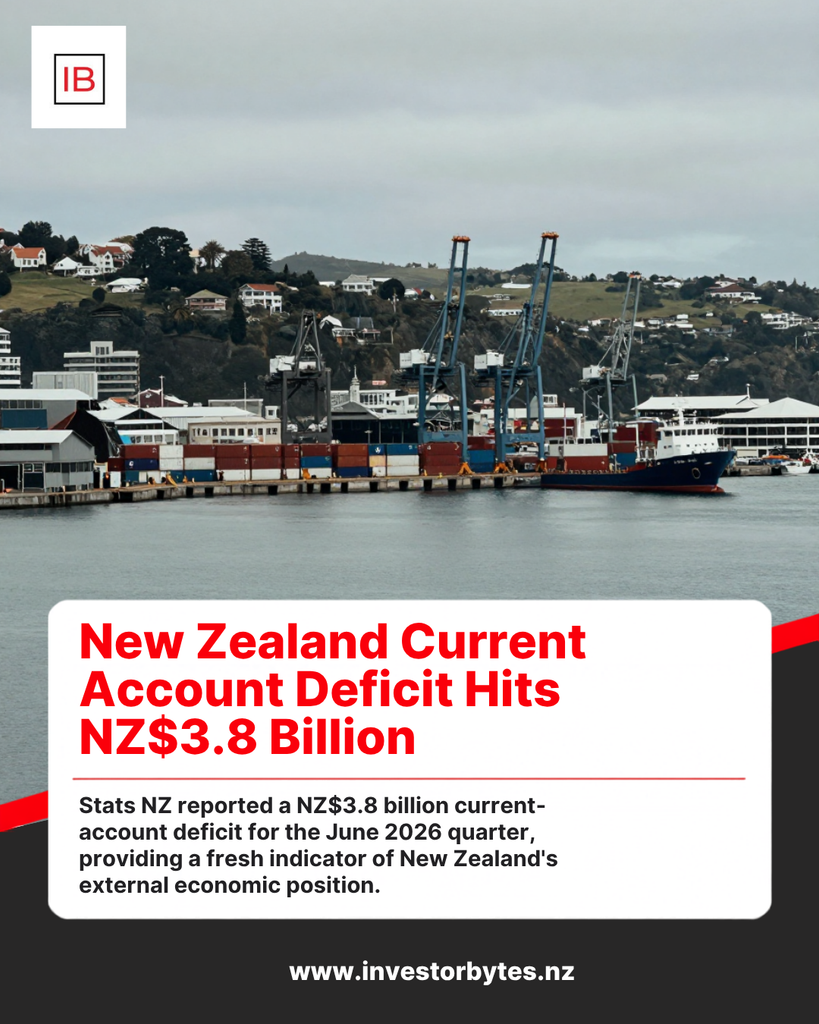
New Zealand Current Account Deficit reached NZ$3.8 billion in the June 2026 quarter, while the annual deficit narrowed to NZ$14.6 billion.
New Zealand Current Account Deficit Hits NZ$3.8 Billion
New Zealand’s current account deficit was NZ$3.8 billion in the June 2026 quarter, according to the latest figures from Statistics New Zealand (Stats NZ). The seasonally adjusted deficit was NZ$666 million narrower than the deficit recorded in the March 2026 quarter.
The latest figures provide an updated view of New Zealand’s external economic position, covering trade in goods and services, investment income and current transfers between New Zealand and the rest of the world.
While the quarterly balance remained in deficit, several components of the balance of payments moved during the June quarter. The primary income deficit narrowed significantly, while the goods deficit widened. At the same time, the services balance moved from a deficit into surplus.
Annual New Zealand Current Account Deficit Narrows
Looking beyond the quarterly result, New Zealand’s current account deficit for the year ended June 2026 was NZ$14.6 billion, equivalent to 3.2% of GDP.
That compares with a NZ$15.8 billion deficit, or 3.6% of GDP, for the year ended June 2025. The annual figures therefore show a narrower external deficit over the 12-month period.
The annual current account measure is useful because quarterly figures can be affected by seasonal movements in exports, imports, tourism, investment income and other international transactions.
For investors and businesses following New Zealand’s economy, the annual figure provides a broader indication of how much the country is receiving from and paying to the rest of the world.
Primary Income Deficit Provides Major Improvement
One of the most important movements during the June quarter was the improvement in the primary income balance.
The primary income deficit narrowed by NZ$712 million, making it the largest contributor to the narrowing of the quarterly New Zealand Current Account Deficit. The primary income balance measures income New Zealand receives from its overseas investments against income paid to foreign investors with investments in New Zealand.
The primary income deficit was approximately NZ$2.3 billion in the June 2026 quarter, compared with NZ$3.1 billion in the March quarter.
New Zealand investors’ earnings from overseas investments increased by NZ$1.1 billion to NZ$5.3 billion during the quarter, with higher dividends from overseas share portfolios contributing to the increase. Meanwhile, income earned by foreign investors from investments in New Zealand rose by NZ$302 million to NZ$7.4 billion.
Goods Deficit Widens
The goods side of New Zealand’s external accounts moved in the opposite direction.
The seasonally adjusted goods deficit widened by NZ$416 million in the June 2026 quarter. The goods deficit reached approximately NZ$1.5 billion, compared with NZ$1.1 billion in the March quarter.
Goods imports increased by NZ$1.8 billion, or 8.2%, to NZ$24.1 billion.
A significant contributor was petroleum and petroleum products. Higher values for diesel, petrol and jet fuel imports contributed to the increase in the value of petroleum imports during the quarter. Reduced-emission motor vehicle imports, including electric, hybrid and plug-in hybrid vehicles, also increased.
At the same time, goods exports also increased. Exports rose NZ$1.4 billion, or 6.6%, to NZ$22.6 billion, with dairy and meat contributing to the increase.
The combination of stronger imports and exports is therefore an important part of understanding the latest New Zealand Current Account Deficit figure.
Services Balance Moves Into Surplus
The services sector provided another positive movement during the quarter.
New Zealand’s seasonally adjusted services balance changed from a NZ$117 million deficit in March to a NZ$183 million surplus in June. This represented a NZ$300 million improvement.
Services exports increased by NZ$193 million to NZ$9.4 billion, while services imports decreased by NZ$107 million to NZ$9.2 billion.
Services trade includes a broad range of international activity, including tourism, transport, business services and other services exchanged between New Zealand residents and overseas economies.
The move into surplus helped offset part of the widening goods deficit during the June quarter.
New Zealand’s International Investment Position
The latest balance-of-payments release also showed changes in New Zealand’s international investment position.
At 30 June 2026, New Zealand’s net international investment liability position stood at NZ$178.3 billion, down from NZ$191.7 billion at 31 March 2026.
That represented a narrowing of NZ$13.5 billion during the quarter. The position was equivalent to approximately 39.0% of GDP, compared with 42.5% of GDP at the end of March.
New Zealand’s international assets increased by NZ$28.6 billion to NZ$523.3 billion, while liabilities increased by NZ$15.1 billion to NZ$701.5 billion.
The rise in international assets was mainly associated with positive price movements in international share markets, while changes in foreign investment and domestic share prices also affected liabilities.
What the Current Account Data Means for Markets
The New Zealand Current Account Deficit is an important economic indicator because it captures New Zealand’s transactions with the rest of the world across goods, services, primary income and secondary income.
A deficit means that, over the measured period, the value of these payments to the rest of the world exceeded receipts from abroad.
However, the headline deficit needs to be viewed alongside its individual components. The June quarter illustrates this clearly: the primary income deficit narrowed substantially and the services balance moved into surplus, while the goods deficit widened.
For financial markets, investors may monitor future current-account releases alongside export and import data, commodity prices, tourism activity, investment income and movements in the New Zealand dollar.
The figures can also provide context for assessing New Zealand’s external financing requirements and international investment position.
Outlook for New Zealand’s External Accounts
The June 2026 data shows that New Zealand’s external position remains in deficit, but the annual New Zealand Current Account Deficit has narrowed compared with the previous year.
The annual deficit of NZ$14.6 billion, equivalent to 3.2% of GDP, was smaller than the NZ$15.8 billion deficit recorded in the year ended June 2025.
Future movements will depend on several factors, including export performance, import demand, global commodity prices, fuel costs, tourism and international investment income.
The latest quarter also demonstrates why looking at the individual components of the current account is important. A stronger services balance and improved primary income position helped reduce the overall quarterly deficit, while higher goods imports widened the merchandise trade deficit.
Conclusion
The New Zealand Current Account Deficit stood at NZ$3.8 billion in the June 2026 quarter, according to Stats NZ. The figure was NZ$666 million narrower than the March 2026 quarter deficit.
For the year ended June 2026, the deficit narrowed to NZ$14.6 billion, equivalent to 3.2% of GDP, compared with NZ$15.8 billion, or 3.6% of GDP, a year earlier.
The June quarter included several notable changes: the primary income deficit narrowed by NZ$712 million, the goods deficit widened by NZ$416 million, and the services balance moved into a NZ$183 million surplus.
For investors tracking New Zealand’s economy, future releases will provide further information about whether the narrowing annual deficit continues and how trade, investment income and international investment flows develop.
External DoFollow Links
Use these authoritative external links in the article:
Stats NZ DataInfo+ — Balance of Payments Statistics
Stats NZ — Current Account Deficit $3.8 Billion
Stats NZ — Balance of Payments and International Investment Position