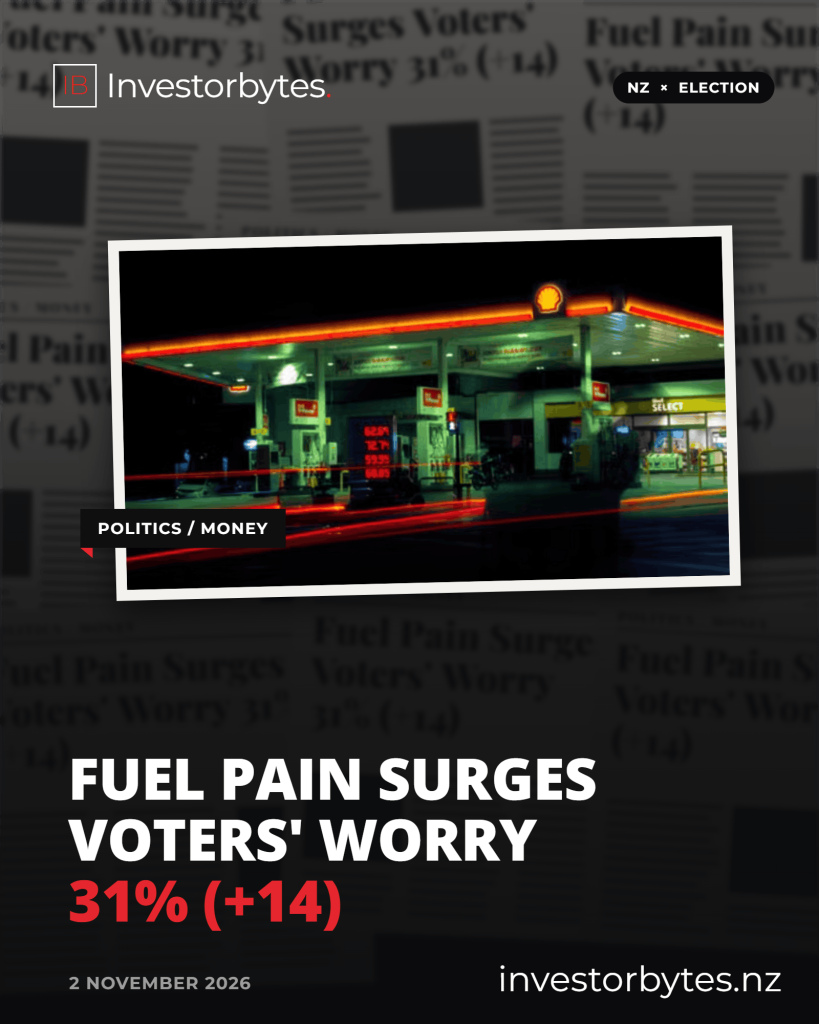
NZ fuel prices are now a top-three voter concern, with 31% naming petrol costs in Ipsos’s latest Issues Monitor, up 14 points. What it means for households.
NZ fuel prices have jumped up the list of issues worrying voters in the final stretch before the general election. The latest Ipsos New Zealand Issues Monitor found that 31% of New Zealanders now rank petrol prices or fuel among the most important issues facing the country, a rise of 14 percentage points in a single month. That lifted fuel from seventh place to third, its highest level since the survey began tracking it.
The October 2026 edition of the Ipsos New Zealand Issues Monitor, released on 1 November and billed as a pre-election special, surveyed 1,008 New Zealanders. Its findings offer a clear snapshot of the pocketbook pressures shaping the mood of households as they head to the polls.
Table of Contents
Fuel Leaps Into the Top Three
A 14-point move in one survey wave is unusually sharp for a tracking poll of this kind. Ipsos links the shift to fuel prices climbing to near-record levels, and its researchers describe the result as a sign of how sensitive households have become to everyday costs ahead of the election.
Fuel now sits behind only two other concerns. Inflation and the cost of living remains the dominant issue, named by 64% of respondents and continuing a gradual climb that began in early 2025. Healthcare and hospitals is second at 45%, the highest reading for that issue since the monitor started in 2018. The economy slipped from third to fourth at 30%, down four points, while unemployment ranked fifth at 19% and housing sat at 18%.
Concern about crime and law and order has eased, falling to 14%, which is 13 points lower than in October 2024. Ipsos noted that fieldwork took place while stories about politicians and gangs were in the headlines, yet respondents still put money matters well ahead of other topics.
Why NZ Fuel Prices Hit Households So Hard
Fuel is one of the most visible prices in the economy. Drivers see it every time they fill up, and it feeds directly into weekly budgets in a way that many other costs do not. For households in regional and rural areas, where public transport options are limited and distances are longer, there is often little ability to cut back. Families with long commutes or several vehicles feel these swings most.
Higher fuel costs also flow through to other prices. Freight, food distribution, trades and many services rely on road transport, so sustained increases at the pump can add to wider inflation over time. That helps explain why fuel concern has risen alongside an already elevated focus on the cost of living.
There has been some offset. Recent RNZ reporting has noted that lower mortgage rates have helped cushion the impact of fuel price rises for some households, although that relief is uneven and does not reach renters or those without a mortgage.
Government Ratings and Party Capability
The survey also asked respondents to rate the government’s performance. The average score held steady at 4.1 out of 10, unchanged from September. About 26% gave a positive rating of seven or more, while 42% gave a negative rating of three or less.
On the question of which party is best placed to handle the top issues, Ipsos reported that Labour was viewed as most capable on all five leading concerns for a third consecutive survey. On inflation and the cost of living, 38% chose Labour and 24% chose National. National continued to lead narrowly on crime and law and order, 29% to 28%. Ipsos did not publish a separate capability breakdown for fuel in its release, and perceptions of capability are not the same as voting intention.
These figures describe how a sample of voters views the parties at one point in time. They do not predict the election result, and different polls measure different things. Voters will weigh a wide range of policies and priorities when they cast their ballots.
What It Means for Investors
For investors, the poll is a reminder that household budgets remain stretched. When a larger share of income goes on fuel and other essentials, discretionary spending tends to come under pressure, which can weigh on retailers, hospitality and other consumer-facing businesses listed on the NZX.
Fuel costs also matter for companies with large transport or logistics exposure, including airlines, freight operators and some primary-sector exporters, whose margins can be squeezed when energy prices rise. On the other side, fuel importers and distributors may see revenue lift, although they also face political and regulatory scrutiny when prices are high.
Elevated fuel costs can also feed into the inflation outlook monitored by the Reserve Bank. Investors with fixed-income holdings or mortgages should keep an eye on how energy prices affect inflation data and expectations for interest rates in the months ahead.
What Households Can Do Now
While no household can control global oil markets or the exchange rate, there are practical steps that can soften the impact. Comparing prices between stations and using fuel discount schemes can make a noticeable difference over a year. Combining trips, carpooling and using public transport where it is available all reduce the amount of fuel needed.
It is also worth reviewing the household budget to see how much fuel now takes up compared with a year ago. Building that higher cost into weekly planning, rather than treating it as temporary, can help avoid surprises if prices stay elevated. Households that rely heavily on a vehicle for work may also want to check whether a more fuel-efficient option, or a mix of transport choices, would make sense over the longer term. Keeping track of NZ fuel prices week by week can help with timing fill-ups and planning larger trips.
Conclusion
The sharp rise in concern about NZ fuel prices shows how quickly everyday costs can reshape the public mood. With nearly a third of New Zealanders now naming fuel a top issue, and the cost of living still well ahead of every other concern, whichever parties form the next government will face strong pressure to address household costs. For investors and households alike, energy prices are likely to remain a key factor to watch through the election period and beyond.
https://nz.investorbytes.com/new-zealand-election-poll-2026/