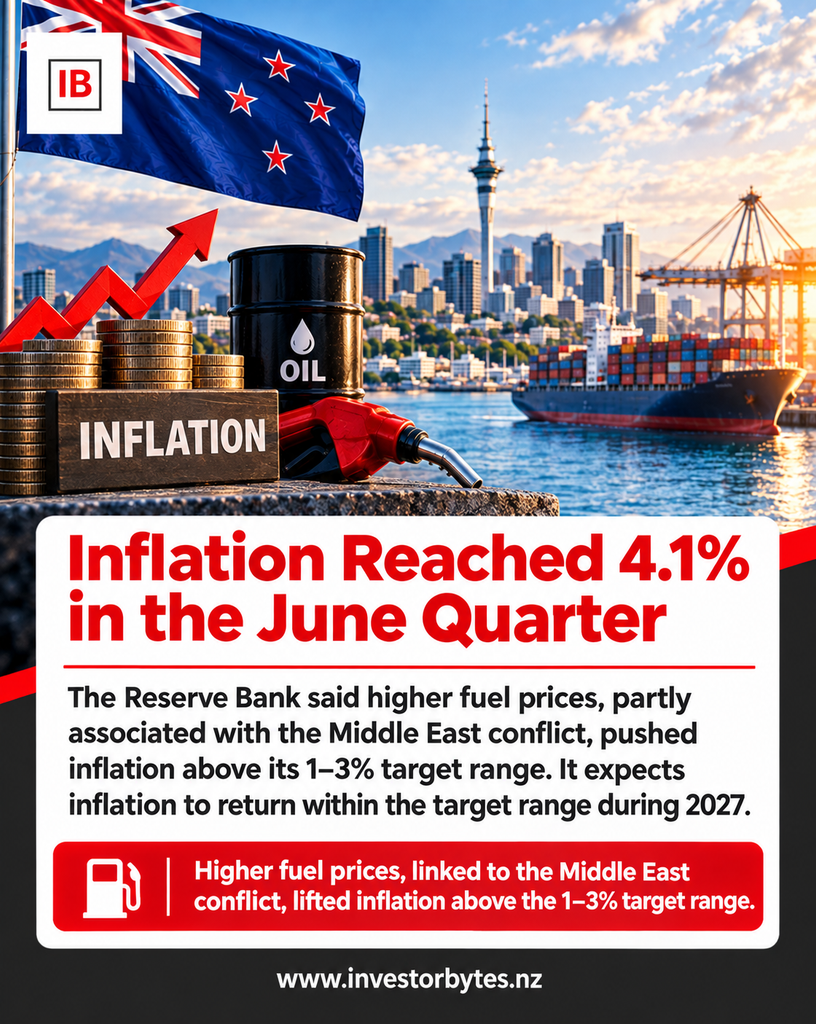
New Zealand Inflation Reaches 4.1% in the June 2026 quarter, driven mainly by higher fuel prices, while underlying inflation remains closer to the RBNZ target.
New Zealand Inflation Reaches 4.1%
New Zealand Inflation Reaches 4.1% in the June 2026 quarter, moving further above the Reserve Bank of New Zealand’s 1–3% medium-term inflation target range.
Annual CPI inflation increased from 3.1% in the March 2026 quarter to 4.1% in June. The Reserve Bank says the increase was largely driven by higher petrol and diesel prices associated with the conflict in the Middle East.
The headline figure is significant for households, businesses and financial markets because persistent inflation can influence interest rates, borrowing costs, wages and consumer spending.
Key Takeaways
- Annual CPI inflation reached 4.1% in the June 2026 quarter.
- Inflation increased from 3.1% in March.
- Higher fuel prices were a major contributor.
- CPI inflation excluding vehicle fuels was 2.9%.
- The RBNZ expects inflation to return to its 1–3% target range by mid-2027.
1. Fuel Prices Are the Main Inflation Driver
The biggest factor behind the latest increase has been fuel.
The RBNZ says higher petrol and diesel prices contributed significantly to the rise in annual inflation. Fuel accounted for 1.2 percentage points of the 4.1% annual CPI inflation rate in the June quarter.
Higher fuel costs can affect the economy beyond petrol stations. Transport companies, manufacturers, retailers and other businesses may face higher operating expenses when fuel becomes more expensive.
Some of these costs can eventually be passed through to consumers in the form of higher prices.
2. Underlying Inflation Is Lower Than the Headline Figure
While headline inflation reached 4.1%, the picture is different when vehicle fuels are excluded.
Annual CPI inflation excluding vehicle fuels fell to 2.9% in the June quarter, placing it within the RBNZ’s 1–3% target range. The central bank also said most measures of core inflation remain within the target range.
This distinction is important because it suggests that a significant portion of the recent inflation increase is linked to fuel and related external pressures rather than a broad acceleration across every part of the economy.
The RBNZ is therefore monitoring whether temporary fuel-price effects become more persistent through wider price and wage-setting behaviour.
3. Higher Costs Could Spread Through the Economy
Fuel prices can affect inflation indirectly as well as directly.
The RBNZ expects higher costs for fuel, plastics, fertilisers and other petroleum-related products to feed into prices across areas including air transport, road transport, food and construction.
This creates a potential second-round effect.
For example, a transport company facing higher diesel costs may experience increased operating expenses. If those costs are passed on, businesses further along the supply chain can also face higher prices.
The RBNZ is particularly focused on preventing these temporary cost increases from becoming embedded in broader price-setting behaviour.
4. Inflation Is Affecting Monetary Policy
The increase in inflation has already influenced the RBNZ’s monetary policy.
In September, the Monetary Policy Committee increased the Official Cash Rate by 25 basis points to 2.75%. The RBNZ said the decision was intended to help return inflation to its 2% midpoint while supporting jobs and economic activity.
Higher interest rates can affect mortgage costs, business borrowing, investment decisions and household spending.
For businesses with significant debt, higher financing costs can influence expansion plans and capital expenditure. For savers, higher interest rates can potentially increase returns on some deposits and fixed-income products.
5. The RBNZ Expects Inflation to Fall
Despite the 4.1% reading, the RBNZ does not expect inflation to remain at this level indefinitely.
The central bank expects inflation to remain elevated through the rest of 2026 before returning to the 1–3% target range by mid-2027 and reaching the 2% midpoint later in 2027.
One reason for this outlook is that the direct impact of higher fuel prices should eventually drop out of the annual inflation calculation.
However, the RBNZ has warned that indirect effects could become more important during the second half of 2026.
Impact on New Zealand Households
Higher inflation can reduce household purchasing power when incomes do not rise at the same pace as consumer prices.
The RBNZ says higher fuel prices are reducing household disposable incomes, while weak income growth and job insecurity are weighing on domestic spending.
Households with high transport expenses can be particularly exposed to fuel-price increases.
At the same time, higher interest rates can add pressure for borrowers refinancing mortgages or taking on new debt.
Impact on Businesses
Businesses are facing a combination of higher input costs and tighter financial conditions.
Fuel-intensive companies may experience direct cost increases, while businesses across manufacturing, transport, agriculture and construction can face indirect pressure from higher energy and petroleum-related costs.
The RBNZ says the country’s economic recovery remains uneven. Strong export prices and demand from trading partners are supporting export-oriented businesses, while weaker household spending is creating challenges for domestic-facing companies.
What Investors Should Watch
For investors following New Zealand markets, several indicators will remain important:
- Future CPI inflation readings
- Petrol and global oil prices
- Core inflation measures
- Wage growth
- Inflation expectations
- Household spending
- Employment conditions
- RBNZ interest-rate decisions
- New Zealand dollar movements
The interaction between fuel prices and underlying inflation will be particularly important in determining how quickly headline inflation moves back toward the RBNZ’s target.
New Zealand Inflation Outlook
The latest inflation data shows that external energy shocks can have a substantial effect on New Zealand consumer prices.
However, the 4.1% headline rate needs to be considered alongside the 2.9% inflation rate excluding vehicle fuels and other core measures that remain within the RBNZ’s target range.
The coming quarters will show whether higher fuel costs remain concentrated in energy-related prices or spread more broadly through the economy.
Final Takeaway
New Zealand Inflation Reaches 4.1% in the June 2026 quarter, with higher fuel prices accounting for a major part of the increase. At the same time, inflation excluding vehicle fuels stood at 2.9%, indicating that underlying price pressures are less elevated than the headline figure suggests.
For investors and businesses, the key factors to monitor are fuel prices, core inflation, interest rates, household spending and the RBNZ’s response to changing inflation conditions.
External Links
Reserve Bank of New Zealand – September 2026 Monetary Policy Statement