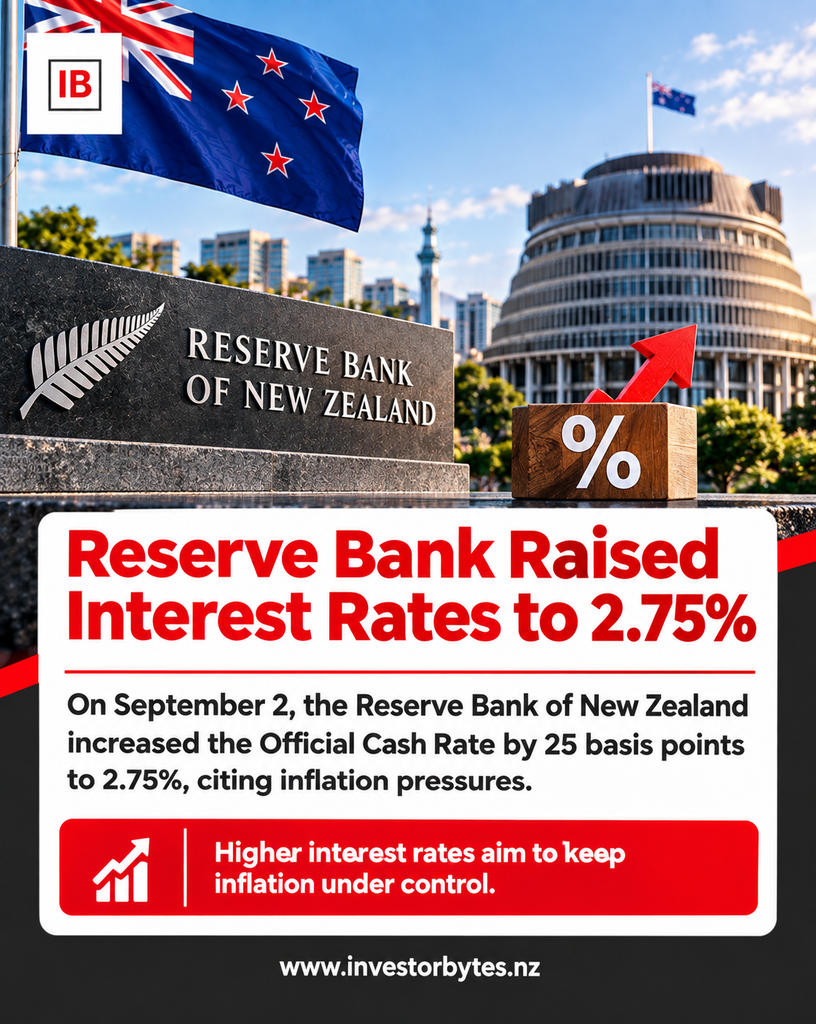
RBNZ Raises Interest Rates to 2.75% as New Zealand tackles 4.1% inflation, higher fuel costs and uneven economic recovery.
RBNZ Raises Interest Rates to 2.75%
The RBNZ Raises Interest Rates to 2.75% after the Reserve Bank of New Zealand’s Monetary Policy Committee increased the Official Cash Rate (OCR) by 25 basis points on September 2, 2026.
The decision came as annual consumer price inflation reached 4.1% in the June 2026 quarter, above the Reserve Bank’s 1–3% target range. The RBNZ said higher fuel prices, linked to the Middle East conflict, were a major contributor to the increase.
Key Takeaways
- The OCR increased by 25 basis points to 2.75%.
- New Zealand’s annual inflation reached 4.1% in June 2026.
- Excluding vehicle fuels, annual inflation was 2.9%.
- The RBNZ expects inflation to return to its 1–3% target range by mid-2027.
- The central bank says further OCR increases could be required, but the future path is not predetermined.
1. The OCR Moves to 2.75%
The RBNZ’s latest decision takes the OCR to 2.75%, following a 25-basis-point increase.
The central bank uses the OCR as its main monetary-policy tool to influence borrowing costs, spending and inflation. Changes in the OCR can feed through to mortgage rates, business lending rates and savings rates.
The September decision was reached by consensus among the Monetary Policy Committee.
The RBNZ said the increase was intended to help return inflation sustainably toward its 2% midpoint while avoiding unnecessary instability in economic activity, employment, interest rates and the exchange rate.
2. Inflation Remains Above the Target Range
Inflation is the central issue behind the latest rate increase.
Annual CPI inflation reached 4.1% in the June quarter, significantly above the RBNZ’s 1–3% target range. However, the central bank noted that excluding vehicle fuels, annual inflation was 2.9%, which is inside the target range.
The RBNZ expects the effects of higher fuel prices to fade from annual inflation calculations over time.
It forecasts inflation returning to the target range by mid-2027 and reaching the 2% midpoint later in 2027.
3. Higher Fuel Prices Are Creating Pressure
The recent inflation increase has been strongly influenced by energy costs.
The RBNZ said higher petrol and diesel prices associated with the Middle East conflict pushed inflation higher. While monetary policy cannot directly lower global oil prices, the central bank said it can prevent temporary energy-price increases from becoming broader, persistent inflation.
This creates a difficult policy environment.
Higher fuel costs increase expenses for households and businesses, while tighter monetary policy can simultaneously increase financing costs.
4. Economic Recovery Remains Uneven
Despite the rate increase, the RBNZ said New Zealand’s economic recovery has most likely resumed.
The central bank highlighted resilient demand from trading partners and strong export prices as sources of support for income growth and investment in export-exposed sectors.
However, domestic conditions remain weaker.
Weak income growth, job insecurity and flat house prices are weighing on household spending and residential investment, particularly in Auckland and Wellington. The RBNZ also said unemployment remains elevated and household consumption growth is weak.
More recent GDP data showed the economy grew 0.2% in Q2 2026, while annual GDP growth reached 2.6%. Construction was the largest positive contributor, increasing 2.7% during the quarter.
5. Further Rate Increases Remain Possible
The latest decision does not establish a fixed path for future interest rates.
The RBNZ said that, conditional on its economic outlook, the OCR may need to increase further. However, it also stressed that future decisions will depend on incoming economic data and the balance of inflation and economic risks.
The next scheduled OCR update is 28 October 2026.
This makes upcoming inflation, employment, household spending and economic activity data important for financial markets.
What the 2.75% OCR Means for Borrowers
A higher OCR generally puts upward pressure on borrowing costs because banks’ wholesale funding costs and lending rates can respond to changes in monetary policy.
The RBNZ reported that domestic financial conditions had already tightened, with higher wholesale interest rates leading to increases in mortgage and business lending rates.
For households, this can affect mortgage refinancing and new borrowing.
For businesses, higher financing costs can influence decisions around expansion, investment and working capital.
Impact on Savers and Investors
Higher interest rates can also affect savers and investors.
Deposit rates may increase as banks compete for funding, although the RBNZ noted that the pass-through of higher wholesale rates to term-deposit rates has been more limited.
For financial markets, expectations about future OCR movements can influence bond yields, the New Zealand dollar and equity valuations.
Export-focused companies can also be affected by currency movements, while businesses with significant debt exposure may face higher financing costs.
New Zealand’s Inflation Outlook
The RBNZ expects inflation to remain elevated during 2026 before gradually declining.
The central bank’s assessment is that most measures of core inflation, longer-term inflation expectations and expected wage growth remain consistent with inflation returning toward its target.
The key risk is whether temporary fuel-price pressure spreads into broader domestic price-setting behaviour.
The RBNZ therefore remains focused on preventing higher headline inflation from becoming persistent.
Final Takeaway
The RBNZ Raises Interest Rates to 2.75% as New Zealand deals with inflation of 4.1%, higher fuel prices and an uneven economic recovery.
The central bank expects inflation to return to its 1–3% target range by mid-2027, while acknowledging that further rate increases may be necessary depending on economic developments.
For investors and businesses, the next important indicators include inflation, employment, household spending, lending rates, the NZ dollar and export performance.