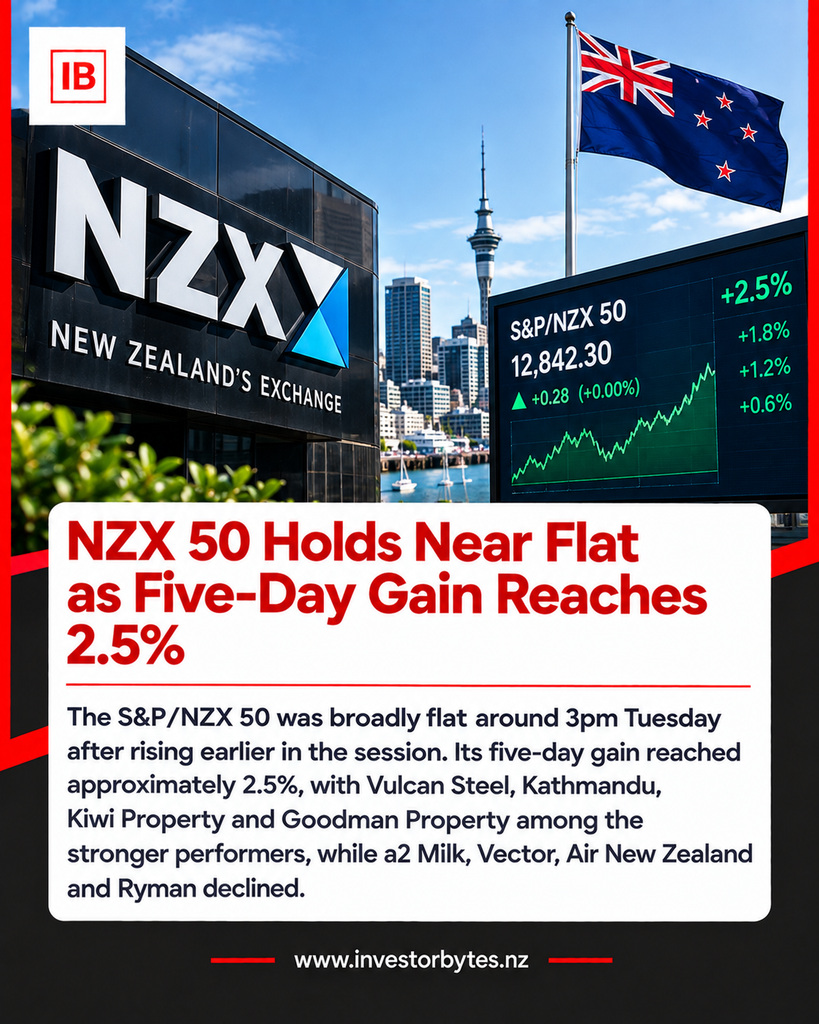
The NZX 50 was broadly flat on September 22 after an earlier rise, while its five-day gain reached approximately 2.5%.
NZX 50: 5 Key Market Signals as Gain Reaches 2.5%
The NZX 50 was broadly flat around 3pm on Tuesday, September 22, after rising earlier in the trading session. The index’s five-day gain had reached approximately 2.5 percent, according to market reporting published during the session.
The move provides a snapshot of recent momentum in New Zealand equities while also showing that individual companies can perform differently from the broader index.
NZX 50 Market Movement
The NZX 50 was barely higher around 3pm after an earlier morning rise.
Market breadth was positive, with 43 gainers compared with 33 decliners at the time of the report. The index had gained approximately 2.5 percent over five trading days.
Because the market was still open when the report was published, the final closing level could differ.
Stronger Performing Shares
Several companies were among the stronger performers during the session.
Vulcan Steel, Kathmandu, Kiwi Property and Goodman Property were identified among the stronger stocks.
These companies represent different parts of the New Zealand market, including industrials and property.
The performance of individual stocks can therefore provide additional information beyond the headline movement of the index.
Declining Stocks
The session also included declines among several well-known companies.
a2 Milk, Vector, Air New Zealand and Ryman were among the companies reported as falling.
This difference between gainers and decliners illustrates why investors often examine market breadth rather than relying only on the index.
An index can remain relatively stable while individual companies experience larger movements.
What the NZX 50 Measures
The NZX 50 is a major benchmark for New Zealand equities.
It provides investors with a broad measure of the performance of listed companies on the NZX.
Changes in the index can reflect company earnings, interest-rate expectations, economic growth, commodity prices, global market conditions and investor sentiment.
The index should therefore be viewed as one indicator rather than a complete representation of the New Zealand economy.
Interest Rates and New Zealand Shares
Interest rates remain an important factor for New Zealand equities.
The Reserve Bank increased the Official Cash Rate to 2.75 percent in September 2026 as inflation remained above the central bank’s target range.
Higher rates can influence company financing costs and the valuation investors place on future earnings.
Property companies can also be particularly sensitive to interest-rate expectations.
Five-Day Performance
The NZX 50 had recorded a five-day gain of approximately 2.5 percent by Tuesday afternoon.
Short-term market performance can change quickly, particularly when investors respond to economic data, company announcements or global market movements.
A five-day gain should therefore be viewed within a broader market context rather than as a standalone indicator.
What Investors Should Monitor
Investors following the NZX should monitor corporate earnings, interest-rate expectations, economic data and international markets.
The New Zealand market is also affected by developments in global equity markets and commodity prices.
The September 22 session demonstrated that the overall index can remain close to flat even when several individual stocks move significantly.
For investors, monitoring both index performance and individual company developments can provide a more complete view of market conditions.
Source: Interest.co.nz – NZX Market Update, 22 September 2026