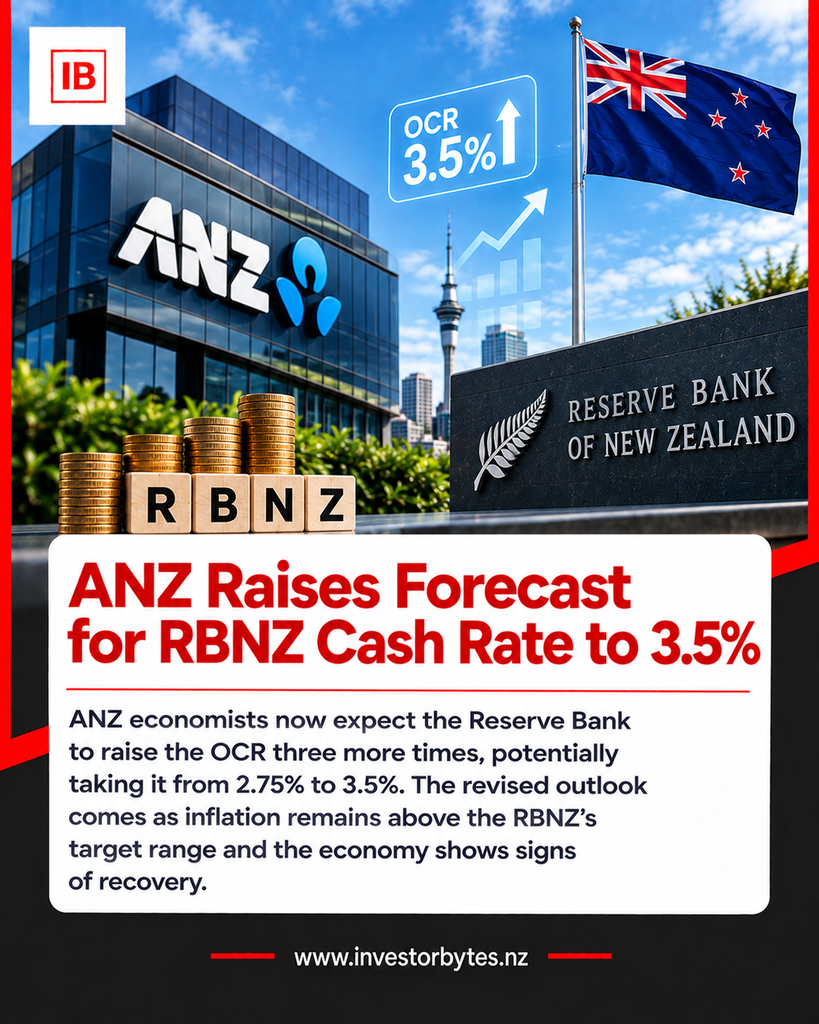
The latest RBNZ cash rate forecast from ANZ sees three more hikes potentially taking the Official Cash Rate from 2.75% to 3.5%.
RBNZ Cash Rate Forecast: 3 Key Factors Behind 3.5%
The latest RBNZ cash rate forecast from ANZ economists sees the Official Cash Rate potentially rising from 2.75 percent to 3.5 percent through three further increases. ANZ’s September 21 economic update lists a forecast path involving hikes in October, February and March.
The forecast comes after the Reserve Bank increased the OCR by 25 basis points to 2.75 percent in September 2026.
Current RBNZ Cash Rate
The Reserve Bank raised the Official Cash Rate to 2.75 percent in September.
The RBNZ said annual inflation had increased to 4.1 percent in the June quarter, above its 1 to 3 percent target range. The Bank attributed much of the increase to higher fuel prices connected to the conflict in the Middle East.
The central bank also said New Zealand’s economic recovery appeared to be resuming, although growth remained uneven.
ANZ’s 3.5% Forecast
The RBNZ cash rate forecast from ANZ represents an economist view rather than a commitment from the Reserve Bank.
ANZ’s September 21 economic update is titled “NZ OCR Call Change – Three hikes Oct/Feb/Mar to 3.5%.”
This means ANZ expects the OCR to rise three additional times.
If all three increases were 25 basis points, the OCR would move from 2.75 percent to 3.5 percent.
Inflation Remains Important
Inflation is one of the main factors influencing monetary policy.
The RBNZ’s September Monetary Policy Statement said inflation had reached 4.1 percent in the June quarter. The Bank expects inflation to return to its target range during 2027, assuming the economic outlook develops as projected.
Persistent energy costs remain an important risk.
If higher costs become embedded in business pricing and wage-setting behaviour, inflation could prove more persistent.
Oil Prices and Interest Rates
Energy prices have become an important part of New Zealand’s inflation outlook.
Higher oil prices can increase transport and production costs. Businesses may face higher costs for fuel, freight and other inputs.
The RBNZ has said that continued energy-price volatility could materially affect the near-term inflation outlook.
This is one reason economists are closely monitoring global energy markets.
Impact on Borrowers
A higher OCR can eventually affect retail interest rates.
Mortgage borrowers, businesses with floating-rate debt and companies refinancing existing loans can be exposed to changes in interest rates.
Higher borrowing costs can reduce disposable income and affect investment decisions.
For savers, however, higher interest rates can increase returns on some deposits and fixed-income products.
Impact on the New Zealand Dollar
Interest-rate expectations can also influence the New Zealand dollar.
If investors expect New Zealand interest rates to rise relative to rates in other economies, this can affect currency-market demand.
However, exchange rates are influenced by many variables, including global risk sentiment, commodity prices, economic growth and international interest rates.
What Investors Should Watch
The RBNZ cash rate forecast is not a guarantee of future policy.
The Reserve Bank itself states that the future OCR path is not predetermined and that policy decisions will depend on economic data and the balance of risks.
Investors should therefore monitor inflation, employment, economic growth, oil prices and RBNZ communications.