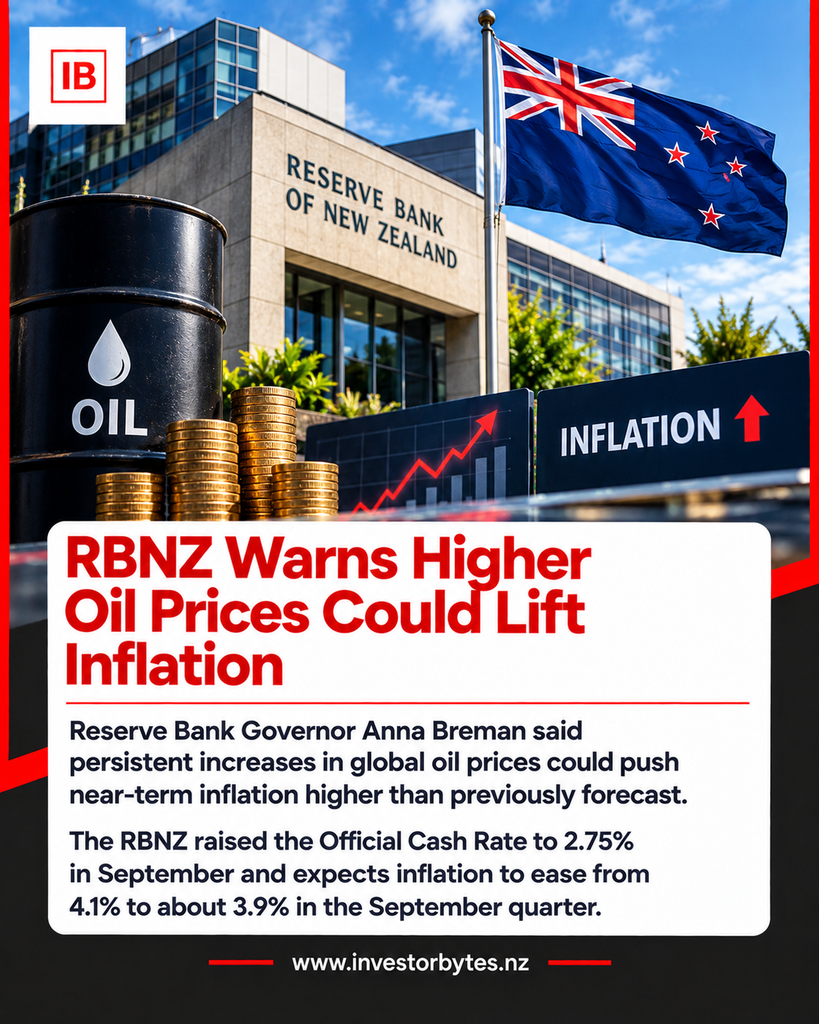
NZ inflation faces renewed risks from higher global oil prices, with RBNZ Governor Anna Breman highlighting potential pressure on near-term prices.
NZ Inflation: 5 Oil Price Risks Highlighted by RBNZ
NZ inflation remains an important issue for financial markets as global oil prices continue to create pressure on costs. Reserve Bank Governor Anna Breman has warned that persistent increases in global oil prices could push near-term inflation higher than previously forecast.
The warning comes after the RBNZ raised the Official Cash Rate to 2.75 percent in September.
Why Oil Prices Matter for NZ Inflation
Oil affects the New Zealand economy through several channels.
Fuel prices directly affect households and businesses. Petrol and diesel costs influence transportation, freight and logistics.
Higher energy costs can also increase the cost of producing and delivering goods.
This means a sustained increase in global oil prices can create broader inflation pressure.
Current Inflation Situation
Annual consumer price inflation reached 4.1 percent in the June 2026 quarter.
The RBNZ said much of the increase was associated with higher fuel prices following the conflict in the Middle East.
The central bank expects inflation to decline as the effects of the fuel-price increase eventually drop out of annual calculations.
However, the outlook remains sensitive to developments in energy markets.
RBNZ Response
The RBNZ increased the Official Cash Rate by 25 basis points to 2.75 percent in September.
The central bank said monetary policy was being adjusted to return inflation toward the 2 percent midpoint over time.
At the same time, the RBNZ recognised that New Zealand’s economic recovery remained uneven.
This creates a policy challenge because higher interest rates can help contain inflation but can also weigh on economic activity.
Oil Prices and Businesses
Businesses face higher costs when energy prices increase.
Transport companies may face higher fuel expenses, while manufacturers can experience increased costs for production and logistics.
Some businesses may absorb these costs, while others may pass some of them through to customers.
The degree of pass-through is important for the inflation outlook.
The RBNZ has highlighted the risk that persistent energy-price increases could influence broader price-setting behaviour.
Impact on Consumers
Households can also feel the impact of higher oil prices.
Fuel is a direct household expense, while higher transportation costs can influence the prices of other goods and services.
If households spend more on energy and transport, they may have less disposable income available for other spending.
The RBNZ has noted that higher fuel and other prices have reduced household disposable incomes.
What It Means for Interest Rates
The relationship between NZ inflation and interest rates is important for investors.
If inflation remains elevated for longer than expected, the RBNZ may need to maintain a tighter monetary policy stance.
However, the central bank has also said future policy decisions are not predetermined.
Economic growth, labour-market conditions, inflation expectations and global energy prices will all remain important.
Market Implications
Oil prices can influence several New Zealand financial-market variables at the same time.
They can affect inflation expectations, interest-rate expectations, business costs and the New Zealand dollar.
Investors should therefore monitor global energy developments alongside domestic economic indicators.
For New Zealand, the key issue is whether higher energy costs remain temporary or become embedded in broader inflation.
Source: Reserve Bank of New Zealand – September 2026 Monetary Policy Statement